
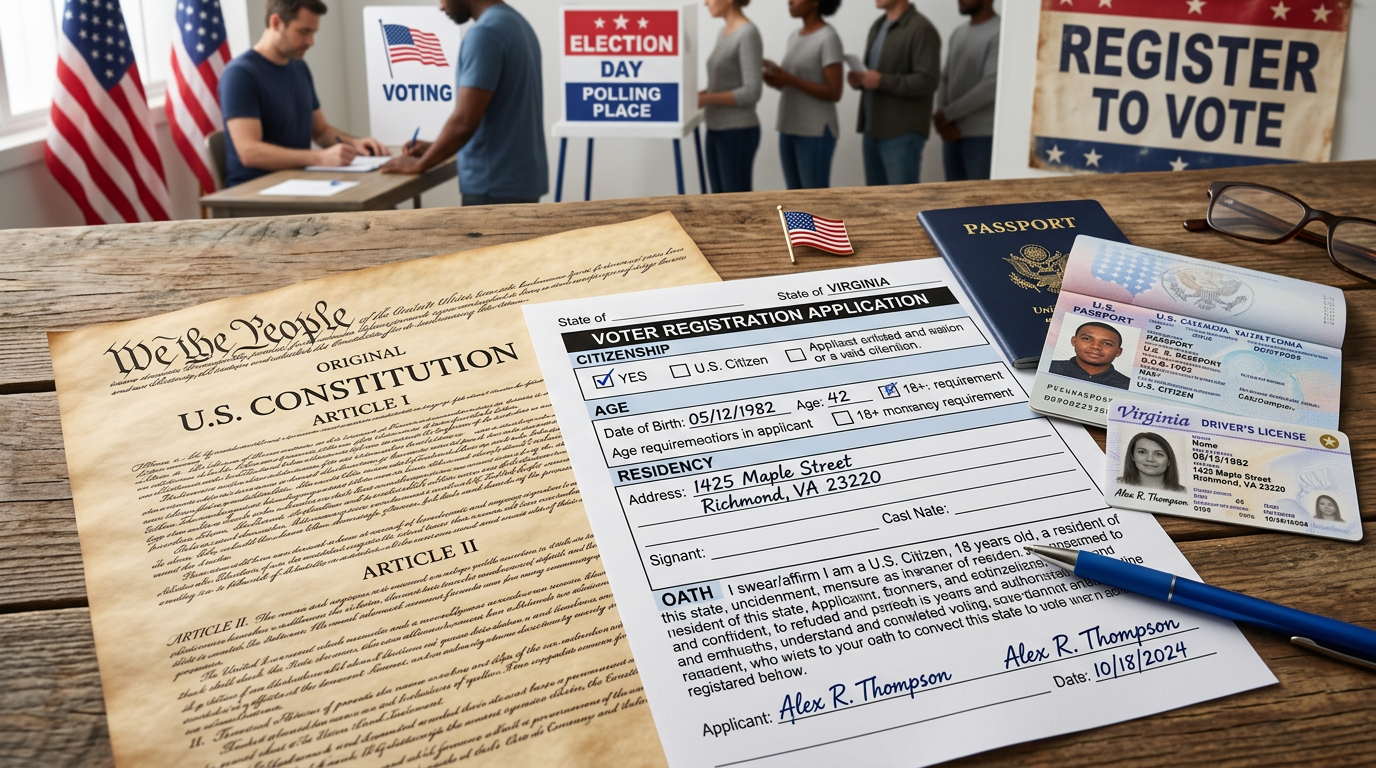
Citizenship, age, residency, registration, and criminal convictions all affect voter eligibility. But the Constitution does not establish every voting qualification, and federal, state, and local elections do not always follow identical rules.
As Americans prepare for the November 2026 midterm elections, one question sits at the center of many debates about election law:
Who is legally allowed to vote?
The answer might seem straightforward: American citizens who are at least eighteen years old.
For most federal elections, that is the starting point.
But it is not the complete answer.
Voters must also meet applicable residency and registration requirements. Certain criminal convictions can affect eligibility. Americans living overseas may retain federal voting rights. Some jurisdictions permit noncitizens to participate in certain local elections, even though federal elections operate under different rules.
These distinctions are important because the United States does not have one universal set of voter-eligibility rules for every election.
The Constitution establishes boundaries. Federal statutes establish additional requirements. States determine many voter qualifications and administer registration systems. Some local governments have additional authority under state law.
Understanding these different sources of authority is essential to distinguishing lawful voting qualifications from unconstitutional restrictions.
What Does the Constitution Say About Voter Eligibility?
The original Constitution did not establish a single national definition of an eligible voter.
Article I, Section 2 provides that members of the House of Representatives are chosen by the people of the states. It also connects qualifications for House voters to those required for voters of the most numerous branch of each state’s legislature.
The Seventeenth Amendment later established direct election of U.S. senators using a similar voter-qualification rule.
This arrangement gave states substantial authority over voter qualifications.
But that authority was never completely independent of the federal Constitution, and subsequent constitutional amendments significantly restricted it.
The Fifteenth Amendment prohibits denial or abridgment of voting rights because of race, color, or previous condition of servitude.
The Nineteenth Amendment prohibits denial or abridgment because of sex.
The Twenty-Fourth Amendment prohibits poll taxes in federal elections.
The Twenty-Sixth Amendment protects citizens eighteen or older against denial or abridgment of voting rights because of age.
The Fourteenth Amendment also establishes constitutional protections relevant to voter qualifications and equal treatment.
The resulting system is one in which states retain significant authority to establish voter qualifications, but they must exercise that authority within constitutional limits.
Citizenship: Who May Vote in Federal Elections?
Federal elections involve choosing members of Congress, the president, and other federal offices filled through elections.
Under current federal election law, noncitizens generally may not vote for federal offices.
This includes lawful permanent residents, commonly called green-card holders.
A person may live legally in the United States, work, pay taxes, own property, and contribute to a community without being eligible to vote in federal elections.
The distinction is between lawful residence and U.S. citizenship.
Title 18, Section 611 of the United States Code generally prohibits noncitizens from voting in elections for federal offices, subject to a narrow statutory exception involving separate voting for certain nonfederal contests.
Federal law also contains requirements relating to citizenship in voter-registration procedures.
One important legal distinction is that the original Constitution does not contain a single clause expressly stating that only citizens may vote in every federal election. Federal statutory law, state voter-qualification law, and constitutional provisions work together in this area.
The precise division of federal and state authority over voter qualifications remains legally significant.
A Current Legal Dispute About Federal Authority
This distinction became especially relevant in October 2026.
On October 1, a federal district judge in Florida ruled that the federal criminal prohibition on noncitizen voting exceeded Congress’s constitutional authority to determine voter qualifications.
The decision arose in a criminal case involving an alleged noncitizen voter.
It is important not to overstate the ruling.
A federal district court decision does not automatically invalidate a statute nationwide or bind every other federal court.
The ruling also does not mean noncitizens are now generally eligible to vote in federal elections.
State voter-qualification laws remain relevant, and the federal statute remains published law while its broader enforceability is subject to the applicable judicial process.
The case illustrates why constitutional analysis must distinguish who qualifies to vote from who possesses authority to establish or enforce a particular qualification.
For readers, the practical rule remains to follow current election-office eligibility requirements and applicable law rather than assume that one district court decision changes voting eligibility nationwide.
Can Noncitizens Vote in Local Elections?
In certain jurisdictions, yes.
Some local governments permit specified noncitizen residents to vote in certain local elections, where state law permits that arrangement.
These elections may involve offices or issues such as municipal government or local education administration.
That does not grant noncitizens the right to vote for president or Congress.
Federal elections and local elections are legally distinct.
A jurisdiction permitting noncitizen voting in a local contest must still comply with applicable federal restrictions concerning federal ballots.
The relevant questions are:
- What office or issue is being voted upon?
- Does state law authorize noncitizen participation?
- What local eligibility requirements apply?
- Are federal-election ballots kept legally separate where necessary?
A statement such as “noncitizens can vote in America” is therefore incomplete without identifying the jurisdiction and election involved.
The opposite statement, “noncitizens cannot vote in any American election,” is also too broad.
Age: Why Eighteen Matters
The Twenty-Sixth Amendment states that the voting rights of U.S. citizens eighteen or older cannot be denied or abridged because of age.
This established the nationwide constitutional protection commonly associated with the voting age of eighteen.
For federal general elections, eighteen is the standard minimum voting age.
Some states permit younger people to register before their eighteenth birthday if they will be eighteen by Election Day.
Certain states also permit seventeen-year-olds to participate in some primary elections if they will be eighteen by the corresponding general election.
That distinction matters because a primary election and a general election may have different eligibility rules.
The Twenty-Sixth Amendment prevents states from excluding otherwise qualified adult citizens because they are under twenty-one, but it does not prohibit states from extending some voting opportunities to younger people where legally authorized.
Residency: Where Are You Legally Entitled to Vote?
Voters ordinarily must satisfy the residency requirements of the jurisdiction in which they seek to vote.
Residency matters because American elections are geographically organized.
A person voting for a state representative must ordinarily be eligible within that representative’s district.
The same principle applies to congressional districts, counties, municipalities, and other electoral jurisdictions.
States may establish reasonable residency requirements.
But they cannot impose every conceivable residency restriction.
In Dunn v. Blumstein (1972), the Supreme Court invalidated Tennessee’s lengthy durational residency requirements, which required one year of state residence and three months of county residence before voting.
The Court held that those requirements violated constitutional protections.
The lesson is that residency may be a legitimate qualification, but the length and operation of a residency requirement can still be unconstitutional.
A person experiencing homelessness also is not automatically disqualified from voting. Eligibility depends on the state’s lawful procedures for establishing voting residence.
Registration: Eligibility Is Not the Same as Registration
Another important distinction is the difference between being legally qualified to vote and being registered to vote.
A person may meet the citizenship, age, and residency qualifications but still need to complete registration before participating in an election.
Most states require voter registration.
North Dakota is the principal exception: it does not require ordinary voter registration.
Registration systems help election officials establish voter records, identify the appropriate electoral jurisdiction, and administer elections.
Federal law also regulates important aspects of voter registration.
The National Voter Registration Act establishes requirements for registration opportunities and voter-list maintenance in covered federal elections.
The Help America Vote Act establishes additional federal election-administration requirements.
Registration deadlines and procedures vary among states.
Some permit Election Day registration.
Others require registration in advance.
These differences do not automatically mean that one state’s rules violate the Constitution.
The legal question is whether the applicable procedures comply with constitutional protections and valid federal law.
What Happens If Someone Moves?
Moving can change the jurisdiction in which a person is eligible to vote.
A move across state lines may require registration in a new state.
A move within a state may require an address update or other action.
Federal law provides certain protections for voters who change residence, but the procedures depend on the circumstances.
Election officials must also maintain accurate registration records without removing eligible voters contrary to applicable law.
The National Voter Registration Act regulates certain voter-list maintenance and removal practices.
That creates two legitimate administrative responsibilities:
Preventing ineligible or outdated registrations from causing problems.
Avoiding improper removal of eligible voters.
These responsibilities are not inherently contradictory.
An accurate registration system must address both.
Can Someone With a Felony Conviction Vote?
The answer depends substantially on state law and the person’s circumstances.
The Constitution does not impose one nationwide rule permanently prohibiting every person convicted of a felony from voting.
Section 2 of the Fourteenth Amendment refers to disenfranchisement associated with participation in rebellion or other crime.
In Richardson v. Ramirez (1974), the Supreme Court relied upon that provision in rejecting an Equal Protection challenge to a state’s felony-disenfranchisement system.
But states have adopted very different approaches.
According to the National Conference of State Legislatures’ September 2026 review:
- Maine, Vermont, and the District of Columbia permit voting even during felony incarceration.
- Twenty-three states generally restore voting rights upon release from incarceration.
- Fifteen states generally restore rights after additional conditions, such as completion of parole or probation.
- Ten states have more restrictive or offense-specific restoration procedures.
These categories summarize broad state approaches and do not replace the precise law governing an individual’s circumstances.
Restoration of voting rights also does not necessarily mean automatic voter registration.
A person whose voting rights have been restored may still need to register or update their registration before voting.
A criminal conviction therefore does not automatically establish permanent ineligibility everywhere in the United States.
Can Someone Awaiting Trial Vote?
Being held in jail does not necessarily mean a person has lost voting rights.
People detained while awaiting trial may remain eligible if they otherwise satisfy applicable voter qualifications.
Similarly, some individuals serving sentences for misdemeanor offenses remain eligible.
The rules depend on the jurisdiction and legal circumstances.
This is an important distinction because incarceration, criminal conviction, and loss of voting rights are not identical concepts.
Election officials and correctional institutions may need procedures that allow eligible incarcerated voters to participate.
What About Mental Disability or Guardianship?
Having a disability does not automatically disqualify a person from voting.
Federal disability-rights protections, including the Americans with Disabilities Act and the Voting Rights Act, protect aspects of voting access and assistance.
Some states have laws addressing voting eligibility following particular judicial determinations of incapacity.
These rules vary and may raise constitutional and federal statutory questions.
The important distinction is that disability itself should not be confused with a lawful, individualized determination of voting eligibility under applicable law.
People with disabilities may also have rights to accessible voting systems and lawful assistance.
Can Americans Living Overseas Vote?
Yes, many U.S. citizens living overseas retain voting rights in federal elections.
The Uniformed and Overseas Citizens Absentee Voting Act, commonly called UOCAVA, establishes protections for qualifying military and overseas voters.
Covered groups include eligible members of the uniformed services, certain eligible family members, and U.S. citizens residing outside the United States.
The law provides mechanisms for registration and absentee voting in federal elections.
For an American serving overseas, physical absence from a state does not automatically eliminate federal voting eligibility.
Rules concerning voting residence, eligibility, ballot applications, and deadlines still matter.
Some states also provide voting opportunities for citizens born abroad who have never resided in the United States, based on parental connections and state law.
Those rules are not identical nationwide.
What About Americans Living in U.S. Territories?
Citizenship alone does not guarantee participation in the presidential general election from every U.S. jurisdiction.
U.S. citizens residing in Puerto Rico, Guam, the U.S. Virgin Islands, and the Northern Mariana Islands generally cannot vote for president in the general election while residing there.
American Samoa has a distinct citizenship and nationality framework.
Territorial residents may participate in other elections, and territories elect congressional delegates or a resident commissioner under applicable law.
Those positions do not carry the same full House voting powers as representatives from states.
This illustrates another important constitutional distinction:
A person’s citizenship status and place of residence can affect which federal elections they may participate in.
What About Dual Citizens?
Possessing citizenship in another country does not automatically disqualify someone from voting in American elections.
A dual citizen who is a U.S. citizen may vote if the person meets the applicable eligibility requirements.
The relevant federal qualification is U.S. citizenship, not exclusive U.S. citizenship.
Other requirements, including age, residence, and registration, still apply.
What About Voter Identification?
As explained in Part 3, voter identification and voter eligibility are separate questions.
A driver’s license may help establish identity.
But it does not necessarily establish U.S. citizenship.
A passport can provide evidence of citizenship and identity, but states do not all require passports to vote.
Registration systems may use identifying information, citizenship attestations, documentary verification, and other procedures as authorized by applicable law.
The relevant distinction is:
Identity: Is this person who they claim to be?
Eligibility: Does this person legally qualify to vote in this election?
A reliable election system must address both questions without imposing unlawful barriers on eligible voters.
Does Every State Have to Use the Same Eligibility Rules?
No.
The Constitution establishes nationwide restrictions on certain qualifications, but it does not require identical voting procedures in all states.
State laws can differ concerning:
- registration deadlines;
- residency procedures;
- restoration of voting rights following convictions;
- participation in certain primaries;
- voter identification;
- and other administrative matters.
Some differences reflect policy choices within constitutional boundaries.
Others may become subjects of litigation.
The relevant legal inquiry is not whether every state uses identical procedures.
It is whether each state’s rules comply with the Constitution and applicable federal law.
Can Congress Change Voter Eligibility Rules?
Congress has substantial constitutional authority over federal election administration.
Article I, Section 4 permits Congress to make or alter state regulations concerning the times, places, and manner of congressional elections.
But the constitutional authority to regulate election procedures is not necessarily identical to the authority to determine voter qualifications.
Article I, Section 2 and the Seventeenth Amendment connect qualifications for congressional voters to qualifications for voters of the most numerous branch of the state legislature.
Congress also has enforcement powers under constitutional amendments protecting voting rights.
The scope of these different powers matters.
A federal law concerning voter registration may rest on different constitutional authority from a law attempting to establish a new voter qualification.
The October 2026 federal district court ruling concerning 18 U.S.C. § 611 demonstrates that disputes over these boundaries remain active.
The Constitution therefore does not permit a complete answer based only on the statement that Congress controls federal elections.
It is necessary to identify the specific constitutional power being exercised.
What Makes a Voting Qualification Unconstitutional?
A state may possess general authority to establish voter qualifications while still adopting a particular qualification that violates the Constitution.
Examples include laws denying voting rights because of race or sex.
Other restrictions may violate the Equal Protection Clause or applicable federal statutes.
Courts also distinguish between eligibility qualifications and election-administration rules.
A lawful residency qualification is not necessarily equivalent to an excessively burdensome residency duration.
A lawful registration requirement is not necessarily equivalent to an unlawful removal of an eligible voter.
A lawful identity-verification procedure is not necessarily equivalent to an unconstitutional burden on voting.
The legality of a voting requirement depends on both the government’s authority and the operation of the particular rule.
Three Questions Every Voter Should Ask
When evaluating a voting-eligibility rule, three questions help establish the legal framework.
First: What election is involved?
Federal, state, and local elections may involve different legal authority.
Second: What law establishes the qualification?
The requirement may come from the Constitution, federal law, state law, or a legally authorized local rule.
Third: Does the qualification comply with higher law?
A state or local rule cannot override applicable federal constitutional protections.
A federal statute must itself rest upon constitutional authority.
These questions help distinguish an actual legal requirement from a political claim about voting.
The Founding Standard Assessment
Who is legally allowed to vote in American elections?
For most federal elections, the ordinary rule is that an eligible voter must be a U.S. citizen, meet the applicable age and residency requirements, satisfy lawful registration procedures, and not be disqualified under applicable law.
But that summary conceals significant legal distinctions.
The original Constitution gave states substantial authority over voter qualifications.
Later amendments restricted that authority by prohibiting specified forms of voting discrimination.
Congress enacted federal laws addressing registration, election administration, voting protections, and noncitizen participation in federal elections.
States retained significant authority over residency, registration, and the restoration of voting rights following criminal convictions.
Some local jurisdictions, where authorized, permit noncitizens to vote in particular local elections.
Military and overseas citizens have additional federal statutory protections.
And the courts continue to address disputes over where federal and state authority begin and end.
These rules demonstrate why two broad claims are misleading.
“Every American citizen can vote in every election.”
That is not an accurate description of eligibility law.
“States can decide who votes without federal constitutional restrictions.”
That is also inaccurate.
The Constitution protects voting while permitting lawful qualifications.
The resulting system seeks to distinguish eligible voters from ineligible voters without violating constitutional protections.
The legal question is not whether voter eligibility should exist.
Every election system must establish who is eligible to participate.
The constitutional question is:
Who has the authority to establish a particular qualification, and does that qualification comply with the Constitution and federal law?
That principle applies regardless of which political party supports a particular election rule.
It also establishes the foundation for the next article in this series:
Part 5 — Mail Voting and Early Voting: What Does the Constitution Actually Require?
There, we will examine how states may establish voting methods, what federal law requires, how absentee ballots are administered, and the constitutional boundaries surrounding voting before Election Day.
Sources and Further Reading
Constitutional Authority and Voter Qualifications
Constitution Annotated — Voter Qualifications for House of Representatives Elections
Congressional Research Service analysis of Article I, Section 2 and the authority of states to establish qualifications for congressional voters.
https://constitution.congress.gov/browse/essay/artI-S2-C1-2/ALDE_00001032/
Constitution Annotated — Constitution of the United States
Official constitutional text, including Articles I and II and the voting-rights amendments.
https://constitution.congress.gov/constitution/
Constitution Annotated — Fourteenth Amendment
Text and analysis of Equal Protection, voting-related provisions, and congressional enforcement powers.
https://constitution.congress.gov/browse/amendment-14/
Constitution Annotated — Twenty-Sixth Amendment
Constitutional protection against age-based denial or abridgment of voting rights for citizens eighteen or older.
https://constitution.congress.gov/browse/amendment-26/
Federal Voter Eligibility and Registration
USAGov — Who Can and Cannot Vote
Official federal overview of citizenship, age, residency, registration, overseas voting, and other eligibility issues.
https://www.usa.gov/who-can-vote
USAGov — How to Register to Vote
Official explanation of voter-registration procedures and state-specific requirements.
https://www.usa.gov/register-to-vote
United States Code — 18 U.S.C. § 611, Voting by Aliens
Federal statutory text addressing noncitizen voting in elections involving federal offices and the exception for separate nonfederal voting.
https://uscode.house.gov/view.xhtml?req=granuleid:USC-prelim-title18-section611
National Conference of State Legislatures — 2026 Election Enactments
Current state legislative developments affecting voter eligibility, citizenship verification, and restoration of voting rights.
https://www.ncsl.org/elections-and-campaigns/2026-election-enactments
Criminal Convictions and Voting Rights
National Conference of State Legislatures — Restoration of Voting Rights for Felons
Updated September 2026. State-by-state comparison of felony disenfranchisement and restoration policies.
https://www.ncsl.org/elections-and-campaigns/felon-voting-rights
National Conference of State Legislatures — Eligible Voters in Jails
Review of voting eligibility for individuals held in jails, including pretrial detainees and other eligible incarcerated voters.
https://www.ncsl.org/elections-and-campaigns/eligible-voters-in-jails
Supreme Court — Richardson v. Ramirez, 418 U.S. 24 (1974)
Decision concerning felony disenfranchisement and the Fourteenth Amendment.
https://supreme.justia.com/cases/federal/us/418/24/
Military and Overseas Voters
U.S. Election Assistance Commission — Military and Overseas Voters (UOCAVA)
Official explanation of federal voting protections for eligible military personnel, their families, and overseas citizens.
https://www.eac.gov/uocava
USAGov — Presidential General Election
Official explanation of presidential voting and the operation of presidential elections.
https://www.usa.gov/presidential-general-election
Constitutional Limits on Residency Requirements
Supreme Court — Dunn v. Blumstein, 405 U.S. 330 (1972)
Decision invalidating lengthy residency requirements for voting under the Equal Protection Clause.
https://supreme.justia.com/cases/federal/us/405/330/
Current Federal Legal Developments
Reuters — Federal District Court Ruling on Noncitizen Voting Statute, October 1, 2026
Reporting on a federal district court decision addressing Congress’s constitutional authority concerning noncitizen voting in federal elections. The decision is not a nationwide binding Supreme Court ruling.
https://www.reuters.com/world/us/judge-finds-law-criminalizing-noncitizen-voting-unconstitutional-2026-10-01/
Article Type: Constitutional and Election-Law Analysis
Series: The Constitution and the 2026 Midterm Elections — Part 4
Primary Category: Constitution
Secondary Category: Civic Responsibility
Publication Date: October 8, 2026
Review Date: October 2027