
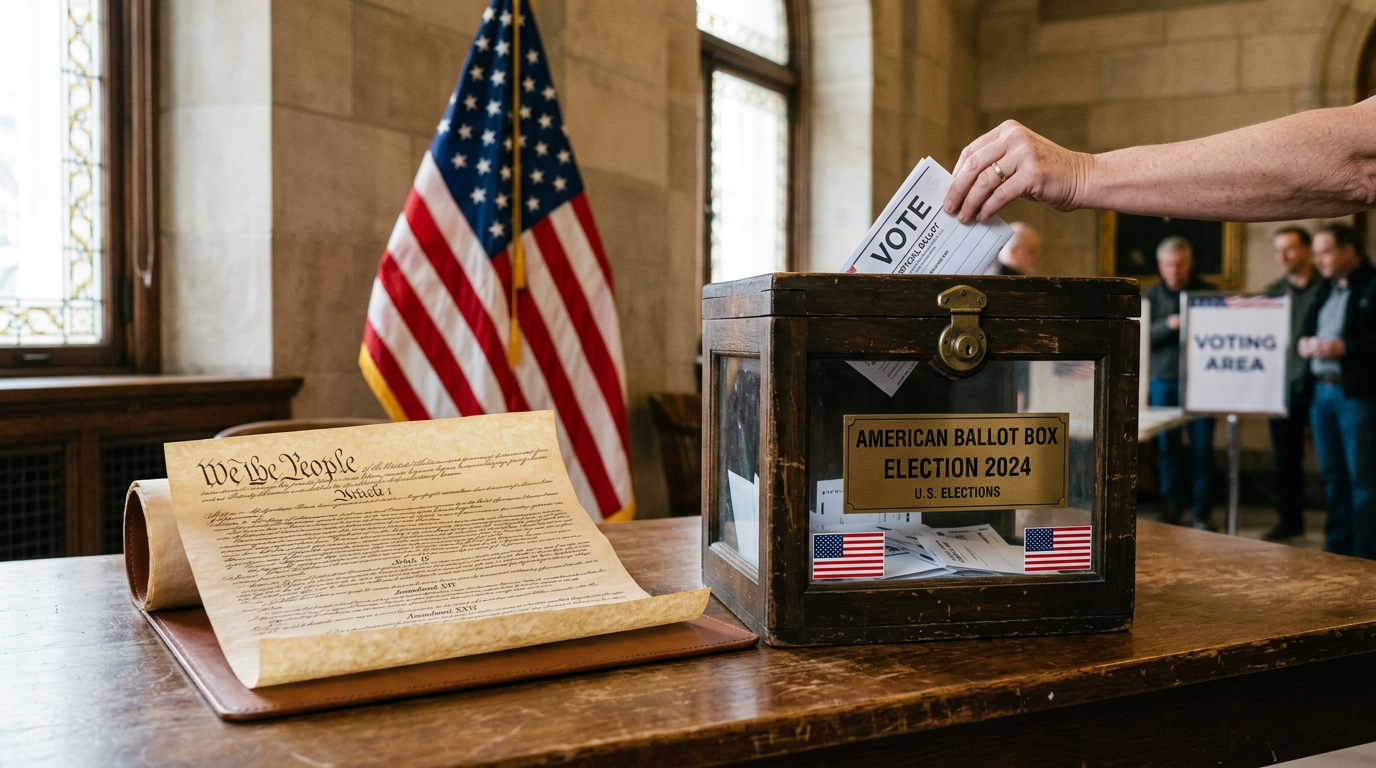
The original Constitution did not establish universal suffrage or define a single nationwide electorate. But constitutional amendments, federal law, and Supreme Court decisions have created extensive protections for voting. So what exactly does the Constitution guarantee—and what authority remains with the states?
Americans routinely describe voting as a constitutional right.
That statement is broadly understandable—but the constitutional story behind it is more complicated than it sounds.
Unlike some rights, the Constitution does not contain a single provision stating simply:
“Every adult citizen has the right to vote in every election.”
The Constitution instead addresses voting through several different provisions adopted over more than two centuries.
The original Constitution established elections for the House of Representatives but largely relied upon state voter qualifications.
Later constitutional amendments prohibited governments from denying or abridging voting rights for specified reasons, including race, sex, failure to pay a poll tax in federal elections, and age for citizens eighteen or older.
The Fourteenth Amendment’s Equal Protection Clause also became an important constitutional protection for voting.
And Congress has enacted federal laws protecting voters and regulating aspects of federal elections.
The result is a constitutional system in which voting is strongly protected, but voter eligibility and election administration still involve significant state authority.
So does the Constitution guarantee the right to vote?
Yes—but understanding exactly what that means requires looking at the Constitution as it exists today, not merely the document ratified in 1788.
What Did the Original Constitution Say About Voting?
The original Constitution did not establish universal voting rights.
Article I, Section 2 provides:
“The House of Representatives shall be composed of Members chosen every second Year by the People of the several States…”
That language is significant.
Members of the House were to be selected by the people, rather than appointed by state legislatures or another governmental institution.
But the Constitution did not create a uniform national definition of who qualified as one of those voters.
Instead, Article I continued:
“…and the Electors in each State shall have the Qualifications requisite for Electors of the most numerous Branch of the State Legislature.”
In practical terms, voter qualifications for House elections were linked to voter qualifications established by the states for their own legislatures.
The federal Constitution therefore created a popularly elected House while leaving substantial authority over voter qualifications with the states.
That had enormous consequences.
Voting at the Founding Was Not Universal
At the time of the Founding, voting qualifications varied among the states.
The original Constitution did not prohibit states from imposing many restrictions that would later become unconstitutional.
Women generally could not vote.
Enslaved people could not vote.
Many free Black Americans faced restrictions or exclusion depending upon the state and period.
Property, taxpaying, residency and other qualifications existed in various jurisdictions.
New Jersey was an unusual early example. Its 1776 constitution used language broad enough to permit some property-owning women and Black residents to vote. The state legislature later restricted voting to free White male citizens in 1807.
The important constitutional point is that the Constitution of 1787 did not establish universal suffrage.
Instead, voting qualifications developed initially through state law and then increasingly through constitutional amendments, federal legislation and judicial interpretation.
The Constitution Changed
This distinction is essential.
When someone asks:
“What did the Founders’ Constitution guarantee?”
and
“What does the Constitution guarantee today?”
those are not necessarily the same question.
The Constitution has been amended twenty-seven times.
Several of those amendments directly concern voting.
The constitutional voting protections Americans possess today therefore cannot be understood by reading only the original seven articles.
The Fifteenth Amendment: Race
Following the Civil War, the Constitution changed dramatically.
The Fifteenth Amendment was ratified in 1870.
It provides:
“The right of citizens of the United States to vote shall not be denied or abridged by the United States or by any State on account of race, color, or previous condition of servitude.”
This language is important for two reasons.
First, it explicitly refers to:
“The right of citizens of the United States to vote.”
Second, it prohibits both federal and state governments from denying or abridging that right for specified reasons.
Congress was also given power to enforce the amendment through appropriate legislation.
But the amendment did not eliminate every possible voting qualification.
Its specific constitutional prohibition concerns discrimination based upon:
- race;
- color;
- or previous condition of servitude.
That distinction would become important in the century following ratification.
Constitutional Protection Did Not Immediately Produce Equal Voting
The existence of the Fifteenth Amendment did not mean its promise was immediately realized.
After Reconstruction, numerous state and local practices were used to prevent or discourage Black Americans from voting.
These included devices such as:
- literacy tests;
- poll taxes;
- grandfather clauses;
- discriminatory registration procedures;
- White-only primaries;
- intimidation;
- threats;
- and violence.
Some of these practices were eventually struck down by courts.
Others were prohibited through constitutional amendments or federal legislation.
The history demonstrates an important distinction:
A constitutional right and the effective enforcement of that right are not necessarily the same thing.
The Nineteenth Amendment: Sex
The next major constitutional expansion came with ratification of the Nineteenth Amendment in 1920.
It provides:
“The right of citizens of the United States to vote shall not be denied or abridged by the United States or by any State on account of sex.”
Again, the Constitution uses the phrase:
“The right of citizens of the United States to vote.”
The amendment prohibited federal and state governments from denying or abridging that right because of sex.
This transformed the constitutional rules governing voting throughout the country.
Before the Nineteenth Amendment, the original Constitution did not prohibit states from establishing sex-based voting restrictions.
After ratification, they could no longer constitutionally do so.
The Twenty-Fourth Amendment: Poll Taxes
Another major change occurred in 1964.
The Twenty-Fourth Amendment provides that the right of citizens to vote in federal elections cannot be denied or abridged:
“…by reason of failure to pay any poll tax or other tax.”
The amendment specifically applies to primary and other elections for:
- President;
- Vice President;
- presidential electors;
- U.S. senator;
- and U.S. representative.
The Twenty-Fourth Amendment therefore prohibited poll taxes in federal elections.
Two years later, the Supreme Court went further in Harper v. Virginia Board of Elections.
The Court held that conditioning participation in state elections on payment of a poll tax violated the Equal Protection Clause of the Fourteenth Amendment.
As a result, wealth or payment of a fee cannot be used as a qualification for voting in state elections either.
The Twenty-Sixth Amendment: Age
The Twenty-Sixth Amendment was ratified in 1971.
It provides:
“The right of citizens of the United States, who are eighteen years of age or older, to vote shall not be denied or abridged by the United States or by any State on account of age.”
This established another nationwide constitutional restriction on government.
A state cannot deny an otherwise qualified citizen who is eighteen or older the right to vote simply because of age.
As with the Fifteenth, Nineteenth and Twenty-Fourth Amendments, Congress was also given authority to enforce the amendment through appropriate legislation.
What About the Fourteenth Amendment?
The Fourteenth Amendment is particularly important because modern constitutional protection of voting does not depend exclusively upon the amendments that explicitly mention voting.
Section 1 provides that no state shall:
“…deny to any person within its jurisdiction the equal protection of the laws.”
Beginning especially in the twentieth century, the Supreme Court applied the Equal Protection Clause to numerous voting disputes.
This produced some of the most consequential voting-rights decisions in American constitutional law.
The Supreme Court Calls Voting a Fundamental Political Right
In Reynolds v. Sims in 1964, the Supreme Court considered unequal representation in state legislative districts.
The Court described the right to vote as a “fundamental political right” because it helps preserve other rights.
The decision became part of the constitutional foundation for the principle commonly summarized as:
one person, one vote.
The principle does not mean every election system must be mathematically identical.
But the Court has required legislative representation to satisfy constitutional population-equality standards.
Voting therefore involves more than merely being permitted to place a ballot into a box.
Constitutional protection can also concern whether votes are treated equally within the relevant electoral system.
So Is Voting a “Fundamental Right”?
Under modern Supreme Court doctrine, voting is treated as a fundamental political right in important constitutional contexts.
But that statement requires precision.
The Supreme Court’s modern voting-rights jurisprudence developed substantially through the Fourteenth Amendment’s Equal Protection Clause.
That is different from saying the original Constitution contained a single, unlimited, affirmative guarantee allowing every citizen to participate in every election under every circumstance.
The Constitution instead contains multiple overlapping protections.
That distinction explains why courts can simultaneously say that voting is fundamental while recognizing that governments may establish lawful voter qualifications and election procedures.
Citizenship Does Not Automatically Mean Eligibility in Every Election
Another important distinction comes from an older Supreme Court case.
In Minor v. Happersett in 1875, Virginia Minor argued that because she was a U.S. citizen, citizenship itself gave her the constitutional right to vote.
The Supreme Court rejected that argument.
The Court recognized Minor as a citizen but concluded that voting was not automatically one of the privileges of citizenship protected by the Fourteenth Amendment’s Privileges or Immunities Clause.
That decision reflected the Constitution as it existed before ratification of the Nineteenth Amendment.
Women later received explicit nationwide constitutional protection against sex-based denial or abridgment of voting through that amendment.
The case nevertheless illustrates an important legal distinction:
citizenship and voter eligibility are related, but they are not identical constitutional concepts.
States Still Establish Voter Qualifications
As discussed in Part 1 of this series, states retain significant constitutional authority over voter qualifications.
Article I ties qualifications for House voters to qualifications for voters of the most numerous branch of the state legislature.
The Seventeenth Amendment uses a similar rule for Senate elections.
But state authority is constrained.
A state cannot establish voter qualifications that violate other provisions of the Constitution.
For example, a state cannot say:
Only men may vote.
Only White citizens may vote.
Citizens must pay a tax before voting.
Citizens over eighteen but under twenty-one cannot vote because of their age.
Those restrictions would conflict with explicit constitutional provisions.
But states can impose legitimate qualifications and election procedures that do not violate the Constitution or valid federal law.
Does That Mean Every Citizen Can Vote?
No.
The Constitution does not establish that every U.S. citizen is eligible to vote in every election regardless of circumstances.
Some basic qualifications remain permissible.
For example, election systems may involve requirements concerning:
- age;
- citizenship;
- residence;
- registration;
- election jurisdiction;
- and compliance with lawful election procedures.
Criminal convictions can also affect voting eligibility under state law.
Section 2 of the Fourteenth Amendment itself contains language referring to abridgment of voting rights for “participation in rebellion, or other crime.”
In Richardson v. Ramirez in 1974, the Supreme Court relied upon that language in upholding California’s disenfranchisement of people convicted of felonies against an Equal Protection challenge.
States differ considerably in how and when voting rights are restricted or restored following criminal convictions.
That is one reason voter eligibility cannot be reduced to the statement:
“If you are a citizen, you can vote.”
The legal framework is more specific.
What About Residency?
States may require voters to be residents of the jurisdiction in which they vote.
That makes practical and constitutional sense because elections select representatives for particular political communities.
But residency requirements themselves can face constitutional limits.
In Dunn v. Blumstein in 1972, the Supreme Court struck down Tennessee requirements that a person reside in the state for one year and in the county for three months before becoming eligible to vote.
The Court concluded that those lengthy durational requirements violated the Equal Protection Clause.
The distinction again matters:
requiring residence and requiring an excessively long period of residence are not necessarily the same constitutional question.
Voting Rights Do Not Eliminate Election Rules
Recognizing voting as constitutionally protected does not mean every election regulation is unconstitutional.
Elections cannot operate without rules.
States establish registration systems.
Election officials maintain voter lists.
Governments determine polling locations.
Ballots must have deadlines.
Officials must determine whether ballots comply with applicable law.
States establish procedures for absentee and mail voting.
Election officials verify voter eligibility.
Votes must be counted, canvassed and certified.
Recounts and election contests require procedures.
The Supreme Court has recognized that states possess legitimate interests in operating elections fairly, honestly and efficiently.
The constitutional question therefore is rarely:
“Does this rule affect voting?”
Nearly every election rule does.
The more useful question is:
“Does this rule impose a constitutionally impermissible burden, discriminate in a prohibited way, or otherwise violate federal law?”
Not Every Voting Regulation Receives the Same Constitutional Treatment
This distinction is especially important for the later articles in this series.
A modest administrative rule and a rule that effectively denies qualified citizens access to the ballot do not necessarily receive identical constitutional treatment.
Courts consider factors such as the nature and severity of the burden and the governmental interests offered to justify election regulations.
This is why broad statements such as:
“Any restriction on voting is unconstitutional.”
are inaccurate.
But the opposite claim—
“States run elections, so any state voting rule is constitutional.”
—is equally inaccurate.
State authority and individual constitutional protections coexist.
Much of election law involves determining where one ends and the other begins.
The Voting Rights Act Added Federal Statutory Protection
Constitutional amendments are only part of the modern voting-rights framework.
Congress enacted the Voting Rights Act of 1965 using its constitutional enforcement powers.
Among its remaining provisions, Section 2 prohibits voting practices or procedures that unlawfully discriminate on the basis of:
- race;
- color;
- or membership in specified language-minority groups.
Section 2 applies nationwide.
The Voting Rights Act therefore provides federal statutory protections in addition to the Constitution itself.
It is important, however, to distinguish the two.
A law can violate:
the Constitution,
a federal statute such as the Voting Rights Act,
both,
or potentially neither.
Those are different legal questions.
Voting Intimidation Is Also Prohibited
Federal law also protects voters against certain forms of intimidation, threats and coercion.
Section 11(b) of the Voting Rights Act prohibits intimidation, threats, coercion or attempted intimidation, threats or coercion involving voting.
According to the Department of Justice, these protections extend through stages of the voting process, including registering, casting ballots and counting votes.
Other federal statutes provide additional protections.
Again, these statutory protections operate alongside constitutional protections.
The Constitution Protects Voting—but Does Not Nationalize Every Election Rule
This is where two competing descriptions of American election law often create confusion.
One side may say:
“Voting is a constitutional right, so states should not be able to regulate it.”
But constitutional rights can be subject to lawful regulations.
Freedom of speech is constitutionally protected, yet government can enforce certain constitutionally permissible time, place and manner rules.
The right to keep and bear arms is constitutionally protected, yet constitutional litigation still concerns which regulations are permissible.
Voting operates within its own constitutional framework as well.
Conversely, another argument may say:
“The Constitution leaves elections to the states, so the federal government has no authority over voting.”
That is also inconsistent with the constitutional text.
The Fifteenth, Nineteenth, Twenty-Fourth and Twenty-Sixth Amendments expressly restrict both the United States and the states.
Several expressly give Congress enforcement power.
And Article I’s Elections Clause independently gives Congress authority to make or alter state regulations concerning the times, places and manner of congressional elections.
The constitutional system therefore contains both:
state election authority
and
federal constitutional voting protections.
What About Voting for President?
Presidential elections add another wrinkle.
The original Constitution does not establish a direct national popular election for president.
Article II provides that each state appoints presidential electors in the manner directed under the constitutional structure governing elector appointment.
Today, every state uses popular elections to select presidential electors.
Once a state uses an election as part of that process, constitutional protections apply to how that election is conducted.
The Twenty-Fourth Amendment also explicitly protects citizens against poll taxes in elections for president, vice president and presidential electors.
The result is another example of why statements about a single universal “constitutional voting clause” can be misleading.
Presidential voting rights arise from an interaction among Article II, constitutional amendments, state law, federal law and Supreme Court precedent.
A Right to Vote Is Not a Right to Have Every Ballot Counted Regardless of the Rules
Another distinction is important.
Constitutional protection of voting does not mean that every ballot submitted must legally be counted regardless of eligibility or election procedures.
Election laws establish rules concerning such matters as:
- voter eligibility;
- registration;
- where a voter may vote;
- ballot deadlines;
- ballot completion;
- absentee-ballot procedures;
- and other requirements.
Whether a particular requirement is lawful depends upon the applicable constitutional, statutory and state-law framework.
Protecting eligible citizens’ ability to vote and enforcing lawful election rules are therefore not inherently contradictory objectives.
An election system requires both voter access and rules determining which ballots are legally valid.
The constitutional disputes arise over where those rules themselves exceed governmental authority or unlawfully burden protected voting rights.
What Does “The Right to Vote” Actually Protect?
Taken together, constitutional text and Supreme Court precedent protect several related principles.
Government cannot deny or abridge voting rights on constitutionally prohibited grounds such as race or sex.
Citizens eighteen or older cannot be denied or abridged the right to vote because of age.
Federal-election voting cannot be conditioned on payment of a poll tax, and the Fourteenth Amendment prohibits poll taxes in state elections as well.
State election laws remain subject to equal-protection requirements.
Representation must comply with constitutional population-equality principles.
Governments may regulate elections, but election regulations remain subject to constitutional review.
Congress may enforce specified constitutional voting protections through appropriate legislation.
Federal statutes provide additional voting protections where Congress possesses constitutional authority to enact them.
That is considerably stronger than saying:
“The Constitution doesn’t mention a right to vote.”
It does.
Several times.
But the Constitution protects voting through a collection of provisions rather than through one universal voting-rights clause.
Why the Wording of the Voting Amendments Matters
There is a fascinating textual feature shared by several amendments.
The Fifteenth Amendment says:
“The right of citizens of the United States to vote shall not be denied or abridged…”
The Nineteenth uses essentially the same formulation.
The Twenty-Fourth refers to:
“The right of citizens of the United States to vote…”
The Twenty-Sixth says:
“The right of citizens of the United States, who are eighteen years of age or older, to vote…”
The Constitution therefore repeatedly recognizes a right to vote while specifying particular grounds on which government may not deny or abridge it.
That structure helps explain the apparent contradiction sometimes encountered in discussions of voting law.
The original Constitution did not create universal suffrage.
Yet the Constitution as amended unquestionably contains explicit voting-rights protections.
Both statements are true.
The Constitution Sets a Floor, Not Every Detail
One useful way to understand the system is to think of federal constitutional protections as establishing boundaries.
Within those boundaries, states retain significant authority over voter qualifications and election administration.
States can also provide voting opportunities beyond federal constitutional minimums where otherwise lawful.
That is why election systems vary.
The Constitution does not prescribe one nationwide model for:
- early voting;
- mail voting;
- voter-registration systems;
- ballot design;
- polling-place hours;
- recount procedures;
- or many other election details.
Some of these areas are also affected by federal statutes.
But substantial differences among states remain constitutionally possible.
The existence of a constitutional right therefore does not require identical election procedures in every state.
The Founding Standard Assessment
So does the Constitution guarantee the right to vote?
The most accurate answer is yes—but not through a single universal provision that eliminates voter qualifications or state election authority.
The original Constitution established popular election of the House of Representatives while largely tying voter qualifications to those established by the states.
It did not establish universal suffrage.
Over time, the Constitution changed.
The Fifteenth Amendment prohibited denial or abridgment of voting rights based on race, color or previous condition of servitude.
The Nineteenth Amendment prohibited denial or abridgment based on sex.
The Twenty-Fourth Amendment prohibited poll taxes in federal elections.
The Twenty-Sixth Amendment protected citizens eighteen or older against age-based denial or abridgment of voting rights.
The Fourteenth Amendment’s Equal Protection Clause became an additional foundation for major voting-rights decisions involving voter qualifications, poll taxes, representation and equality.
The Supreme Court has consequently described voting as a fundamental political right and recognizes constitutionally protected participation in elections.
But none of this means that states have lost the authority to establish legitimate voter qualifications or election procedures.
Residency can matter.
Registration can matter.
Eligibility can matter.
Election procedures can matter.
Criminal convictions can affect voting rights under state law within the applicable constitutional framework.
And states remain the principal administrators of American elections.
The constitutional principle is therefore more precise than either side of the common argument suggests.
It is incorrect to say simply:
“There is no constitutional right to vote.”
The Constitution expressly refers multiple times to “the right of citizens of the United States to vote,” and Supreme Court precedent provides substantial constitutional protection for political participation.
But it is also incorrect to say:
“Because voting is a constitutional right, every citizen may vote in every election regardless of qualifications or procedures.”
The Constitution protects voting while permitting governments to establish lawful election rules.
That distinction will become increasingly important as we move deeper into this series.
The central constitutional question is not simply whether government may regulate voting.
It can.
The question is:
When does a legitimate election rule become an unconstitutional denial or abridgment of the right to vote?
That brings us directly to Part 3:
Voter ID: What Can States Constitutionally Require?
There we will examine voter-identification laws using the framework established in Parts 1 and 2: state authority, individual voting rights, federal law, Supreme Court precedent, election integrity and the constitutional limits on each.
Sources and Further Reading
The Constitution
Constitution Annotated — Constitution of the United States
Official congressional resource containing the full constitutional text and Congressional Research Service analysis.
https://constitution.congress.gov/constitution
Constitution Annotated — Article I, Section 2
Text establishing popular election of the House and linking voter qualifications to those required for voters of the most numerous branch of each state’s legislature.
https://constitution.congress.gov/constitution/article-1
Constitution Annotated — Voter Qualifications for House Elections
Congressional Research Service analysis of state authority over voter qualifications and the constitutional and federal limitations on that authority.
https://constitution.congress.gov/browse/essay/artI-S2-C1-2/ALDE_00001032
National Archives — Voting Rights
Historical overview explaining how the original Constitution did not define who could vote and how later constitutional amendments expanded federal voting protections.
https://www.archives.gov/news/topics/voting-rights
National Archives — Amendments 11–27
Official transcripts of the later constitutional amendments, including the Fourteenth, Fifteenth, Seventeenth, Nineteenth, Twenty-Fourth and Twenty-Sixth Amendments.
https://www.archives.gov/founding-docs/amendments-11-27
Fourteenth Amendment and Voting
Constitution Annotated — Voting Rights Generally
Congressional Research Service analysis of voting rights under the Equal Protection Clause, including representation, redistricting and constitutional voting protections.
https://constitution.congress.gov/browse/essay/amdt14-S1-8-2-1/ALDE_00013630
Constitution Annotated — Fourteenth Amendment, Section 2
Analysis of the amendment’s treatment of voting, representation and disenfranchisement for participation in rebellion or other crime, including Richardson v. Ramirez.
https://constitution.congress.gov/browse/essay/amdt14-S2-1/ALDE_00000847
Fifteenth Amendment
National Archives — Fifteenth Amendment
Official history and transcript of the amendment prohibiting denial or abridgment of voting rights because of race, color or previous condition of servitude.
https://www.archives.gov/milestone-documents/15th-amendment
Constitution Annotated — Fifteenth Amendment
Constitutional text and Congressional Research Service analysis.
https://constitution.congress.gov/browse/amendment-15
Nineteenth Amendment
Constitution Annotated — Nineteenth Amendment
Constitutional text and analysis of the prohibition against denying or abridging voting rights because of sex.
https://constitution.congress.gov/browse/amendment-19
Constitution Annotated — Women’s Suffrage from the Founding Era
Historical analysis of state voting qualifications and women’s voting rights before ratification of the Nineteenth Amendment.
https://constitution.congress.gov/browse/essay/amdt19-2-1/ALDE_00013823
Twenty-Fourth Amendment
Constitution Annotated — Twenty-Fourth Amendment
Text and analysis of the constitutional prohibition against poll taxes in federal elections.
https://constitution.congress.gov/browse/amendment-24
Twenty-Sixth Amendment
Constitution Annotated — Twenty-Sixth Amendment
Text and analysis of constitutional voting protection for U.S. citizens eighteen years of age or older.
https://constitution.congress.gov/browse/amendment-26
Federal Voting-Rights Laws
U.S. Department of Justice — Introduction to Federal Voting Rights Laws
Official DOJ overview of federal voting-rights protections and the history and operation of the Voting Rights Act.
https://www.justice.gov/crt/introduction-federal-voting-rights-laws-1
U.S. Department of Justice — Section 2 of the Voting Rights Act
Official explanation of Section 2’s nationwide prohibition against specified forms of racial and language-minority discrimination in voting.
https://www.justice.gov/crt/section-2-voting-rights-act
U.S. Department of Justice — Voting Rights Fact Sheet
Official overview of federal protections concerning discrimination, voter intimidation, assistance and other voting rights.
https://www.justice.gov/crt/voting-rights-fact-sheet
U.S. Department of Justice — Voting Section
DOJ division responsible for enforcing the civil provisions of major federal voting-rights statutes.
https://www.justice.gov/crt/voting-section
Federal Voter Eligibility
Congressional Research Service — Federal Voter Eligibility and Voter Registration: Overview and Issues for Congress
Current congressional analysis of constitutional and statutory voter qualifications, citizenship, age, registration and federal election requirements.
https://www.congress.gov/crs_external_products/R/PDF/R48735/R48735.2.pdf
Article Type: Constitutional and Election-Law Analysis
Series: The Constitution and the 2026 Midterm Elections — Part 2
Primary Category: Constitution
Secondary Category: Civic Responsibility
Published: September 2026
Review Date: September 2027