
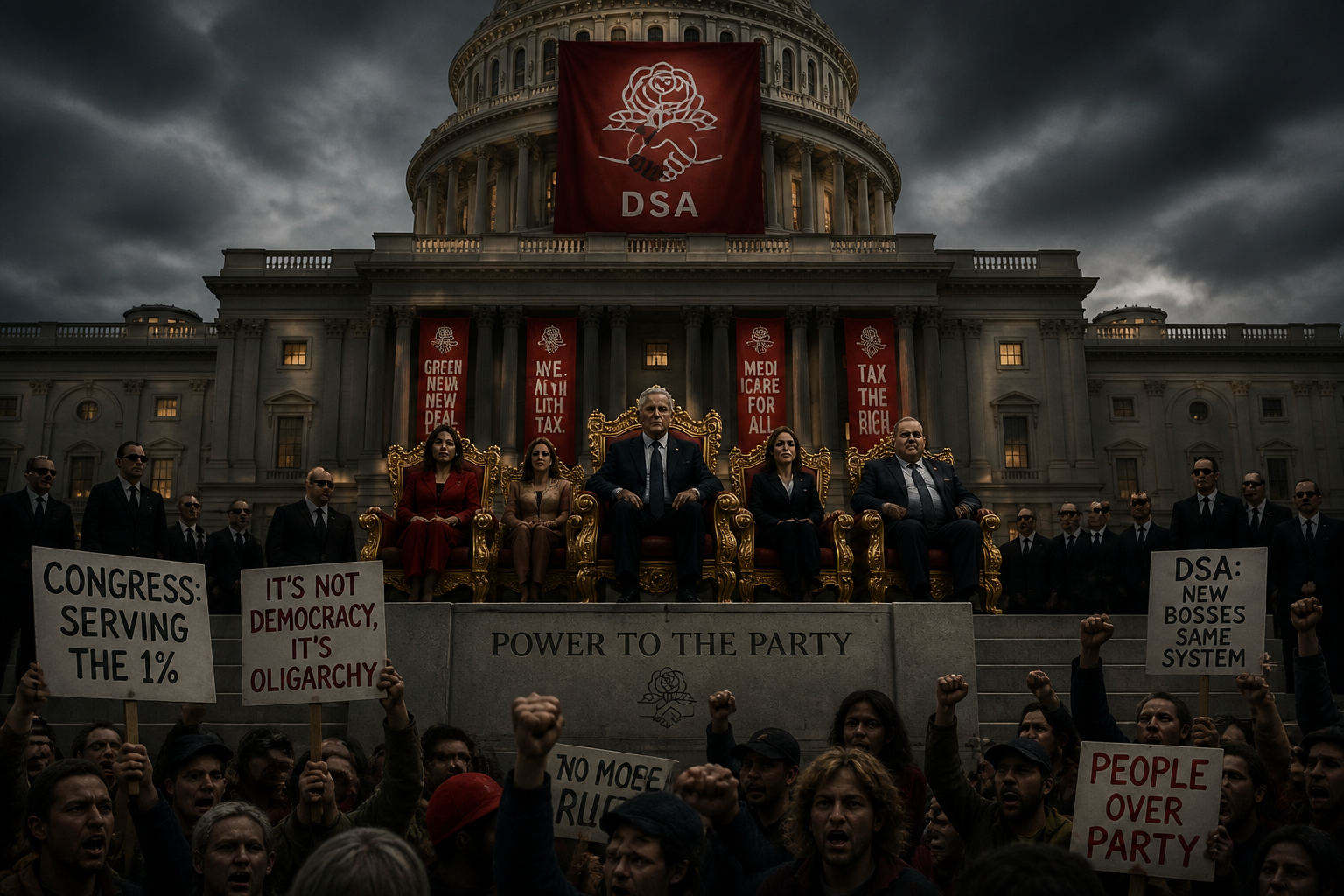
The Democratic Socialists of America says concentrated wealth gives a small economic elite too much power over American government. Its proposed solution would dramatically reduce private economic power while giving a restructured Congress substantially greater authority. Would that eliminate concentrated power—or change where it resides?
The Democratic Socialists of America identifies a serious problem in American politics:
concentrated power.
More specifically, DSA argues that concentrated private wealth allows wealthy individuals and corporations to exercise disproportionate influence over government and society.
Its current national program, Workers Deserve More, describes the existing system as a “capitalist oligarchy” and proposes extensive economic and political changes intended to replace it with what DSA calls a more democratic system.
DSA proposes public ownership of the largest corporations and essential industries, aggressive wealth taxation, publicly financed elections, elimination of dark money and lobbying, stronger organized labor, proportional representation, and other changes intended to reduce concentrated private influence.
But DSA’s program also proposes something considerably more fundamental.
It calls for abolishing the Senate and Electoral College and replacing the existing president and Supreme Court with an executive and judiciary “chosen by and subordinate to Congress.”
DSA also says its larger objective is to:
“draft a new constitution, and create a democratic socialist republic.”
Those proposals raise an important question that is separate from whether DSA is correct about the influence of wealth in American politics:
If concentrated private power is dangerous, how should concentrated governmental power be controlled?
That question goes directly to one of the central disagreements between DSA’s proposed political system and the constitutional structure governing the United States today.
DSA’s Diagnosis: Economic Power Becomes Political Power
To understand DSA’s proposed solution fairly, its diagnosis should first be presented on its own terms.
DSA’s constitution says American society contains a fundamental conflict between sectors possessing enormous economic power and the majority of the population.
Its current program is even more direct.
DSA argues that America’s political and economic systems allow a relatively small class of wealthy individuals and corporations to exercise disproportionate power.
Its proposed remedies include:
- aggressive wealth taxes;
- public ownership of major corporations and essential industries;
- stronger organized labor;
- publicly financed elections;
- eliminating dark money;
- eliminating lobbying;
- proportional representation;
- expanding the House of Representatives;
- abolishing the Senate;
- abolishing the Electoral College;
- and fundamentally restructuring the executive and judicial branches.
These proposals share an underlying objective.
DSA seeks to reduce the ability of concentrated private wealth to determine political and economic outcomes.
Whether its proposed policies would accomplish that objective is a separate question.
But reducing oligarchic economic power is clearly one of the organization’s stated goals.
What Is an Oligarchy?
The word oligarchy is frequently used as a political insult, so defining it matters.
In its traditional political meaning, oligarchy refers to government or political power controlled by a relatively small group.
Economic oligarchy is somewhat different.
It describes circumstances in which concentrated wealth gives a relatively small group disproportionate influence over economic or political decision-making.
The United States is not formally organized as an oligarchy.
Americans elect representatives.
Government authority is divided constitutionally.
Courts enforce legal rights.
Political parties compete for office.
Power changes hands through elections.
But the existence of democratic institutions does not make questions about disproportionate political influence meaningless.
Wealthy individuals, corporations, labor organizations, advocacy groups, political parties, ideological organizations, and other organized interests all attempt to influence government.
How much influence wealth should purchase—and what government should do about it—is a legitimate democratic debate.
DSA proposes addressing that problem partly by reducing private concentrations of economic power.
The constitutional question is what happens to public power in the process.
DSA Would Give Congress a Very Different Role
Under the Constitution today, Congress is powerful but not supreme.
Article I gives legislative power to Congress.
Article II establishes an independently elected president exercising executive power.
Article III creates an independent federal judiciary.
The Congressional Research Service explains that these separate vesting clauses form the foundation of the constitutional separation of powers.
DSA proposes a substantially different structure.
Its current program states:
“Replace the President and Supreme Court with an executive and judiciary chosen by and subordinate to Congress.”
It separately proposes:
“abolish the Senate.”
The resulting national legislature would therefore be very different from Congress as it exists today.
There would no longer be a Senate checking the House.
There would no longer be an independently elected president possessing a separate constitutional source of authority.
And the judiciary would no longer occupy the same independent constitutional position relative to the legislature.
DSA proposes making Congress more representative through proportional representation, ranked-choice voting, expansion of the House, public election financing, and a multiparty political system.
The organization therefore does not simply propose giving today’s Congress additional power.
It proposes creating a different Congress within a different political system.
That distinction is important.
But another question remains:
What checks the new Congress?
Why the Constitution Divides Power
The American constitutional system begins from a premise that is somewhat different from DSA’s approach.
It assumes that concentrated governmental power itself presents a danger.
The Constitution therefore divides authority horizontally among three branches and vertically between federal and state governments.
Congress writes laws.
The president executes them.
Courts adjudicate cases.
Congress is itself divided between the House and Senate.
The president can veto legislation.
Congress can override presidential vetoes under specified conditions.
The Senate participates in appointments and treaties.
Congress controls appropriations and possesses impeachment powers.
Federal judges receive institutional protections intended to preserve judicial independence.
Courts exercise judicial review.
States retain substantial independent governmental authority.
These arrangements deliberately create friction.
The Congressional Research Service explains that the Constitution’s checks and balances were designed to prevent the gradual accumulation of governmental powers in one department.
The system does not assume that any particular branch—or political majority—will always exercise power wisely.
Instead, it creates institutions with both the authority and incentive to resist encroachment by the others.
The Fundamental Difference
That reveals a significant philosophical difference between the two approaches.
DSA’s program seeks to make government more democratic by placing greater authority in a legislature it expects to be more directly representative of the population.
The existing Constitution attempts to protect democratic government partly by preventing any representative majority from controlling every part of the federal government simultaneously.
Those are not necessarily competing definitions of democracy.
They are competing ideas about how democratic power should be restrained.
DSA places greater emphasis on democratic representation.
The existing constitutional structure places greater emphasis on institutional checks in addition to elections.
That distinction matters because elections answer only one of two important questions.
Who should exercise political power?
Constitutional structure asks another:
How much power should those people possess once elected?
Does Moving Power to Congress Solve the Oligarchy Problem?
This is where DSA’s proposal presents an unresolved institutional question.
Suppose DSA is correct that concentrated wealth currently gives wealthy individuals and corporations disproportionate influence over Congress.
Now suppose Congress becomes considerably more powerful.
The executive is subordinate to it.
The judiciary is subordinate to it.
The Senate no longer exists.
What prevents wealthy individuals, corporations, unions, ideological movements, political parties, advocacy organizations, or other organized interests from attempting to influence that more powerful legislature?
DSA does have an answer.
Its proposed political restructuring occurs alongside its economic restructuring.
The organization seeks to reduce extreme concentrations of private wealth, establish public ownership of major industries, strengthen labor organizations, eliminate lobbying and dark money, publicly finance elections, and introduce proportional representation.
In DSA’s model, therefore, the legislature would not simply receive additional authority while everything else remained unchanged.
The economic and electoral systems would change alongside it.
That is essential to understanding the proposal fairly.
But it does not entirely resolve the institutional problem.
Even if economic inequality were dramatically reduced, political organizations and competing interests would still seek political influence.
Political power itself can become concentrated independently of private wealth.
That leads to a different question:
Does changing who is expected to control concentrated power solve the problem of concentrated power itself?
Economic Oligarchy and Political Oligarchy Are Different Problems
This distinction deserves particular attention.
An economic oligarchy concentrates economic resources and influence among a relatively small group.
A political oligarchy concentrates political authority among a relatively small group.
One does not automatically produce the other.
And eliminating one does not automatically prevent the other.
A country could theoretically have widely distributed private wealth but highly concentrated governmental authority.
It could also have competitive democratic institutions alongside enormous concentrations of private wealth.
Those are different problems requiring different safeguards.
DSA’s program focuses heavily on democratizing economic ownership and political representation.
The existing constitutional structure focuses heavily on dividing governmental power among competing institutions.
The real constitutional question is whether one safeguard can substitute for the other.
What About Term Limits?
That question becomes more significant when congressional tenure is considered.
The Constitution currently establishes terms of office but does not impose term limits on members of Congress.
Members of the House serve two-year terms.
Senators serve six-year terms.
Both may repeatedly seek reelection.
The Supreme Court addressed attempts by states to impose additional congressional qualifications in U.S. Term Limits, Inc. v. Thornton in 1995.
The Court concluded that states cannot independently add qualifications for membership in Congress beyond those contained in the Constitution.
A nationwide congressional term-limit requirement would therefore raise constitutional questions that cannot simply be resolved by individual states imposing their own restrictions.
DSA’s current national program proposes enormous changes to Congress.
However, the program does not include a general proposal establishing congressional term limits.
That fact needs to be interpreted carefully.
It does not establish that DSA wants legislators to remain in office permanently.
It does not establish an intention by DSA politicians to entrench themselves in government.
And it does not prove that DSA opposes congressional term limits as a matter of principle.
It establishes only what the current program says and does not say:
DSA proposes greatly increasing the institutional importance of Congress without pairing that proposal with congressional term limits in its current national program.
DSA Does Use Limited Terms Internally
There is another important distinction.
DSA itself uses fixed leadership terms.
Its National Political Committee—the organization’s principal national leadership body between conventions—is elected every two years.
DSA’s constitution also provides two-year terms for its national chair or co-chairs.
That demonstrates that the organization uses recurring leadership elections internally.
But a term and a term limit are not the same thing.
A two-year term means an official must face another election or selection after two years.
A term limit means that after serving a specified number of terms, that person becomes ineligible to continue serving.
DSA’s internal use of two-year leadership terms therefore should not be presented as equivalent to a proposal limiting how long members of Congress could remain in office.
Would Congressional Term Limits Solve the Problem?
Even if congressional term limits were added to DSA’s proposal, another distinction would remain.
Term limits restrict who can exercise power for how long.
Separation of powers restricts what an institution can do regardless of who controls it.
Those safeguards solve different problems.
Imagine a legislator is permitted to serve only six years.
A term limit guarantees that the individual eventually leaves office.
It does not necessarily prevent the institution in which that legislator serves from possessing enormous power during those six years.
Conversely, under separation of powers, even a legislator who serves for decades cannot constitutionally exercise presidential or judicial authority merely because Congress wants to do so.
Term limits can therefore address political entrenchment.
They do not substitute for structural limits on governmental authority.
Elections Are Also a Check—But Not the Same Check
DSA could reasonably respond that democratic elections provide accountability.
If legislators abuse their authority, voters can remove them.
That is unquestionably an important democratic safeguard.
But elections and separation of powers operate differently.
Elections periodically determine who holds office.
Constitutional checks restrict what officeholders can do between elections.
Under the current Constitution, even a Congress supported by an overwhelming electoral majority cannot simply assume all executive and judicial power.
Popularity does not erase constitutional boundaries.
That limitation is intentional.
The constitutional system assumes that democratic legitimacy alone does not make unlimited governmental power safe.
The Most Useful Test: Give the Power to Your Opponent
There is a simple way to evaluate proposals for expanded governmental authority without relying on partisan preference.
Imagine DSA’s proposed political structure is implemented.
The Senate has been abolished.
The executive is subordinate to Congress.
The judiciary is subordinate to Congress.
A more representative national legislature exercises substantially greater governmental authority.
Now change one fact.
DSA loses the election.
A political movement fundamentally opposed to democratic socialism wins control of Congress.
That movement now inherits exactly the same institutional powers.
Would supporters of DSA’s constitutional model still consider those powers appropriately limited?
The same test applies to every political movement.
A conservative supporting expansive presidential authority should ask whether that authority remains acceptable when a progressive president exercises it.
A progressive supporting broad federal regulatory authority should ask whether the same authority remains acceptable under conservative control.
A populist seeking weakened judicial constraints should consider what happens when political opponents control the legislature.
Constitutional restraints are most meaningful precisely when political power changes hands.
Madison’s Answer to the Problem
The Framers confronted a version of this problem when designing the Constitution.
James Madison addressed it in Federalist No. 51.
His argument was not that political leaders would necessarily be corrupt.
It was that institutions should be designed around the reality that human beings possess competing ambitions and interests.
The constitutional response was to give separate institutions the ability to resist one another.
Congress should have political power.
So should the executive.
So should an independent judiciary.
The result is inefficient by design.
Legislation becomes harder.
Majorities encounter obstacles.
Government sometimes deadlocks.
Those are genuine costs.
But the friction serves another purpose:
making concentrated governmental power harder to obtain.
Public Ownership Adds Another Dimension
DSA’s economic program makes this institutional question even more significant.
The organization proposes:
“public ownership of the largest corporations and essential industries.”
Public ownership is not inherently unconstitutional.
Federal, state, and local governments already own substantial infrastructure and enterprises.
But widespread public ownership would increase the economic responsibilities exercised through government.
Under DSA’s broader political model, therefore, a more powerful legislature would exist alongside a government possessing substantially greater influence over major parts of the economy.
That does not prove such a system would become authoritarian or oligarchic.
Those conclusions would go beyond the available evidence.
But it does increase the importance of answering another institutional question:
What independent institutions restrain the government when both political authority and significant economic authority reside within the public sector?
The question is particularly relevant because DSA’s stated objective is preventing concentrated power from dominating society.
Could DSA’s System Become a Political Oligarchy?
The available evidence cannot tell us what a hypothetical future DSA-designed government would ultimately become.
Claiming that it would inevitably become an oligarchy would therefore be speculation.
But institutional risk can still be examined.
DSA’s program would remove or fundamentally alter several institutions that currently operate as checks on Congress.
At the same time, it proposes expanding public authority over major areas of economic life.
Its response is greater democracy:
more representative elections,
multiple political parties,
proportional representation,
public election financing,
greater worker organization,
and reduced private concentrations of wealth.
Those mechanisms could create meaningful political accountability.
The constitutional counterargument is that democratic accountability and institutional checks are not mutually exclusive.
A government can have elections and divided power.
The American Constitution deliberately attempts to provide both.
The relevant question is therefore not whether DSA supports elections.
It clearly does.
The question is whether electoral accountability provides an adequate substitute for the independent institutional checks that its program proposes eliminating.
Concentrated Private Power Is Also a Legitimate Constitutional Concern
Criticism of DSA’s institutional design should not obscure the problem DSA is attempting to address.
Concentrated private economic power can influence government.
Corporations and wealthy individuals can finance political advocacy.
Organized interests lobby government.
Economic power can provide access and influence unavailable to ordinary citizens.
American history also contains repeated efforts to address concentrated economic power through antitrust law, campaign-finance regulation, banking regulation, labor law, disclosure requirements, and other policies.
The constitutional debate therefore does not require choosing between two absolutes:
unrestrained corporate power
or
unrestrained governmental power.
A constitutional republic can attempt to restrain both.
That possibility deserves serious consideration because solving one concentration-of-power problem by creating another would defeat the purpose.
A Different Way to Frame the Debate
The disagreement between DSA’s model and the existing constitutional model can therefore be reduced to two different approaches.
DSA’s approach
Reduce concentrated private wealth.
Democratize economic ownership.
Make elections more representative.
Reduce institutional barriers to majority government.
Place greater authority in a representative legislature.
The existing constitutional approach
Permit majority rule within constitutional boundaries.
Divide governmental authority among competing branches.
Divide legislative authority between two chambers.
Maintain an independently elected executive.
Maintain an independent judiciary.
Divide authority between federal and state governments.
Protect individual rights from ordinary political majorities.
Neither description establishes which system would produce better policy outcomes.
It identifies the structural difference.
And that difference is substantial.
The Founding Standard Assessment
DSA raises a legitimate democratic concern when it asks whether concentrated wealth gives a relatively small number of people disproportionate influence over American politics.
That question should not be dismissed simply because it comes from a socialist organization.
The United States has repeatedly confronted the relationship between economic concentration and political influence throughout its history.
But identifying concentrated private power as a problem does not automatically establish that concentrating greater governmental power is the solution.
DSA’s current national program proposes both economic and constitutional transformation.
It seeks to reduce concentrations of private wealth through public ownership, taxation, organized labor, campaign-finance changes, and other policies.
At the same time, it proposes abolishing the Senate and making the executive and judiciary subordinate to Congress.
DSA argues that this would occur within a more democratic political system featuring proportional representation, expanded participation, public election financing, and multiple political parties.
That is important context.
The proposal is not simply:
give today’s Congress unlimited authority.
It is:
restructure the political and economic system and give a newly designed representative legislature substantially greater authority.
But that still leaves a fundamental question unanswered.
What institution independently checks that legislature?
DSA’s current national program does not pair its proposed increase in congressional authority with congressional term limits.
That absence does not establish a desire for permanent incumbency or political entrenchment.
But even term limits would address only part of the problem.
Term limits constrain individual officeholders.
Separation of powers constrains institutions.
The existing Constitution assumes that elections alone are insufficient protection against concentrated governmental authority.
Its solution is to divide power so that ambition, political competition, courts, states, separate branches, and elections all operate simultaneously as restraints.
DSA proposes reducing several of those institutional restraints while increasing democratic control over the remaining legislature.
That creates the central constitutional question examined in this article:
Does replacing concentrated private economic power with more concentrated democratic governmental power actually solve the problem of concentrated power?
The evidence cannot tell us how a hypothetical DSA government would ultimately behave.
It would therefore be unsupported to conclude that DSA members seek personal control over Americans or that a DSA-designed government would inevitably become authoritarian.
But the structural consequences of the organization’s published proposals can be evaluated.
If implemented as written, DSA’s program would remove several institutions through which the current Constitution disperses federal authority and would place substantially greater political authority in Congress.
That is not speculation.
It follows from the institutional changes DSA itself proposes.
Americans evaluating those proposals should therefore consider more than whether they agree with DSA’s economic objectives.
They should consider what happens after political power changes hands.
A constitutional rule should not be judged only by what preferred leaders might do with it.
It should also be judged by what their opponents could do with exactly the same authority.
That provides a useful test for DSA’s proposals—and for proposals from every political movement:
Would you still support giving government that power if the people you trust least were the ones exercising it?
That question lies near the heart of the American system of checks and balances.
Sources and Further Reading
Democratic Socialists of America — Primary Sources
Democratic Socialists of America — Workers Deserve More: Current National Program
DSA’s current national program. Primary source for its stated objective of ending capitalist oligarchy and its proposals concerning a new constitution, Congress, the presidency, Supreme Court, Senate, Electoral College, elections, public ownership and economic democracy.
https://program.dsausa.org/
Democratic Socialists of America — Constitution and Bylaws
DSA’s current governing document, as amended by its 2025 National Convention. Describes its analysis of concentrated economic power and establishes the organization’s leadership structure and two-year terms for the National Political Committee and national chair/co-chairs.
https://www.dsausa.org/about-us/constitution/
Democratic Socialists of America — Leadership and Structure
Official DSA description of the National Political Committee, its role and its election every two years.
https://www.dsausa.org/about-us/structure/
U.S. Constitution and Separation of Powers
Constitution Annotated — Constitution of the United States
Official congressional resource containing the constitutional text and Congressional Research Service analysis.
https://constitution.congress.gov/constitution/
Constitution Annotated — Separation of Powers Under the Constitution
Congressional Research Service examination of the constitutional division of legislative, executive and judicial authority and the reasons for maintaining institutional checks.
https://constitution.congress.gov/browse/essay/intro-7-2/ALDE_00000031/
Constitution Annotated — Separation of Powers and Checks and Balances
Explains bicameralism, the presidential veto, judicial independence, judicial review, appointments, impeachment and other mechanisms through which the branches constrain one another.
https://constitution.congress.gov/browse/essay/artI-S1-3-1/ALDE_00013290/
Constitution Annotated — Article I, Section 1
Constitutional text establishing Congress as a bicameral legislature consisting of a House of Representatives and Senate.
https://constitution.congress.gov/browse/article-1/section-1/
Congressional Terms and Term Limits
Constitution Annotated — Qualifications for Members of Congress
Congressional Research Service analysis discussing Powell v. McCormack and U.S. Term Limits, Inc. v. Thornton, including the Supreme Court’s conclusion that states cannot add qualifications for congressional membership beyond those established by the Constitution.
https://constitution.congress.gov/browse/essay/artI-S2-C2-3/ALDE_00013373/
Supreme Court — U.S. Term Limits, Inc. v. Thornton, 514 U.S. 779 (1995)
Supreme Court decision holding that states may not impose congressional qualifications beyond those established in the Constitution.
https://supreme.justia.com/cases/federal/us/514/779/
Founding-Era Explanation of Checks and Balances
Library of Congress — Federalist No. 51, James Madison
Madison’s explanation of the need for governmental institutions capable of checking one another and preventing the concentration of political authority.
https://guides.loc.gov/federalist-papers/text-51-60
Library of Congress — Federalist No. 47, James Madison
Discussion of separation of legislative, executive and judicial authority and the dangers associated with concentrating governmental powers.
https://guides.loc.gov/federalist-papers/text-41-50
Article Type: Constitutional and Political-Ideology Analysis
Primary Category: Democratic Socialists of America (DSA)
Secondary Categories: Constitution; Civic Responsibility
Published: September 2026
Review Date: September 2027