
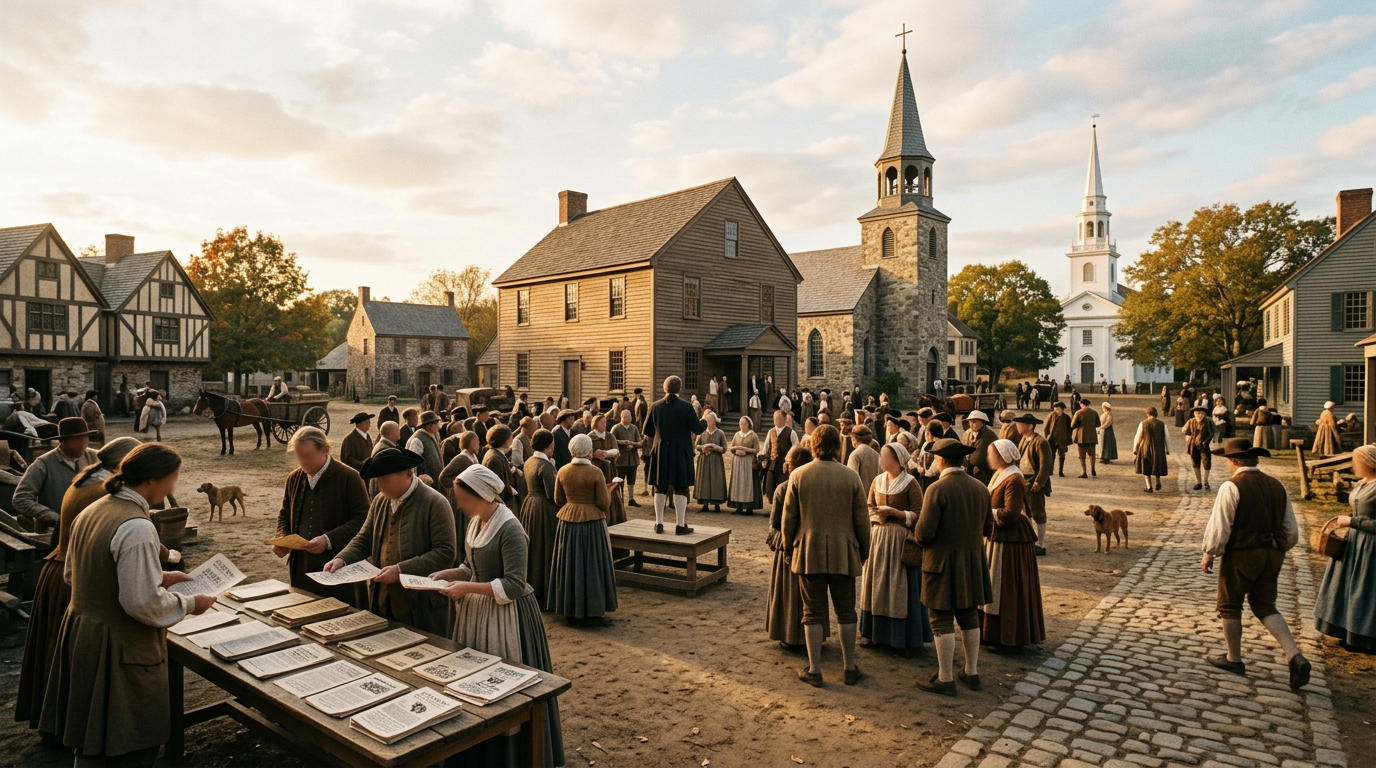
Christianity profoundly influenced early American society, politics, and culture. But the federal Constitution did not establish the United States as a Christian government. The historical record shows both realities at the same time.
Article Type: Historical Analysis
Primary Category: American History
Secondary Category: Constitution / Religion and Political Islam
Published: September 2026
Review Date: September 2027
Few questions about the American Founding generate more confident answers—or more selective use of evidence—than this one:
Was the United States founded as a Christian nation?
Some Americans answer yes and point to the religious beliefs of the colonists, Christian language used by political leaders, congressional prayer, state religious establishments, and the influence of Biblical ideas on early American culture.
Others answer no and point to the Constitution’s prohibition on religious tests, the First Amendment, Jefferson’s Virginia Statute for Religious Freedom, Madison’s opposition to state-supported religion, and the Treaty of Tripoli.
Both sides can cite authentic historical evidence.
The difficulty is that they are often answering different questions.
“Christian nation” can mean at least three things:
- Was early American society predominantly Christian and heavily influenced by Christianity?
- Did Christian ideas influence the political culture in which the United States was founded?
- Did the federal Constitution establish Christianity as the official religion or legal foundation of the United States government?
The historical evidence supports different answers to those questions.
American society at the Founding was overwhelmingly shaped by Christianity.
Christian ideas and institutions clearly influenced American political culture.
But the Constitution created a federal government that did not establish Christianity as an official national religion and specifically prohibited religious tests for federal office.
The most accurate answer, therefore, is not simply yes or no.
It depends upon what we mean by “Christian nation.”
Christianity Was Deeply Embedded in Colonial America
Any serious examination of the question must begin by acknowledging the enormous role Christianity played in early American life.
Many of the British colonies that eventually became the United States were settled by people whose religious convictions shaped their communities, laws, education, and institutions.
The Library of Congress notes that several colonies were established in significant part as religious communities and that religious belief played a central role in colonial life. Library of Congress — Religion and the Founding of the American Republic
New England Puritans built communities around Congregational Christianity.
Pennsylvania became closely associated with Quaker religious principles.
Maryland was founded in part as a refuge for English Catholics, although its religious history later became more complicated.
Anglicanism was formally established in several southern colonies.
Religious institutions provided education, charity, community organization, and moral instruction.
Christian churches were therefore not marginal institutions in colonial America.
They were central to society.
The Library of Congress has documented substantial religious participation during the eighteenth century, including the influence of the Great Awakening and rapid growth of churches and evangelical denominations.
It would therefore be historically inaccurate to describe the society that produced the American Revolution as secular in the modern sense.
Religion was deeply woven into American public and private life.
Christianity Also Influenced the Revolution
Religion did not disappear when political resistance to Great Britain began.
Clergy participated in debates about independence.
Sermons interpreted the political struggle through theological ideas.
Religious language appeared in revolutionary arguments.
Some ministers argued that resistance to British authority could be morally justified.
The Library of Congress describes religion as playing a major role in the Revolution by providing moral justification for opposition to British rule. Library of Congress — Religion and the American Revolution
The Declaration of Independence itself contains religious language.
It refers to:
“Nature’s God,”
the rights endowed by a “Creator,”
the “Supreme Judge of the world,”
and “divine Providence.”
These references demonstrate that religious concepts were part of the intellectual vocabulary of the revolutionary generation.
But another distinction is necessary.
The Declaration does not establish a Christian denomination.
It does not mention Jesus Christ.
It does not require belief in Christianity as a condition of citizenship.
Religious language in the Declaration is therefore significant evidence of a theistic political culture, but it does not by itself establish that the later Constitution created a Christian government.
The Continental Congress Was Openly Religious
The national institutions that preceded the Constitution also engaged openly with religion.
In September 1774, the First Continental Congress opened its proceedings with prayer.
Congress later employed chaplains.
The Continental and Confederation Congresses issued proclamations calling for days of prayer, thanksgiving, fasting, and repentance.
The Library of Congress notes that the Congress governing the country between 1774 and 1789 devoted considerable attention to encouraging religious practice. Library of Congress — Religion and the Congress of the Confederation
In 1787, the Northwest Ordinance declared:
“Religion, morality, and knowledge” important to good government and the happiness of mankind and encouraged schools and education.
That language is difficult to reconcile with claims that the founding generation believed religion should have no role whatsoever in public life.
They clearly did not.
But again, the historical question is not merely whether the Founders valued religion.
The question is whether the federal government they created was constitutionally Christian.
For that, we must examine the Constitution itself.
The Constitution Is Strikingly Reserved About Religion
The Constitution drafted in Philadelphia in 1787 contains surprisingly little religious language.
It does not invoke God in its operative text.
It does not identify Christianity as the national faith.
It does not require government officials to profess Christianity.
It does not require the president to be Christian.
It does not establish a national church.
The Library of Congress notes that the Constitution’s relative silence concerning religion troubled Americans on both sides of the issue—some who wanted greater recognition of religion and others who feared the possibility of national religious establishment. Library of Congress — Religion and the Federal Government
The most explicit provision concerning religion appears in Article VI.
It states:
“no religious Test shall ever be required as a Qualification to any Office or public Trust under the United States.”
U.S. Constitution — Article VI
That language matters enormously.
At a time when religious qualifications for public office were not unusual, the federal Constitution prohibited them.
A person did not have to demonstrate adherence to Christianity—or any other religion—to hold federal office.
That is difficult to reconcile with the argument that the Constitution established Christianity as the official legal basis of the federal government.
The Absence of a Religious Test Was Controversial
The prohibition on religious tests did not go unnoticed.
Some opponents of the proposed Constitution worried that Article VI could allow non-Christians—or even people with no religious belief—to hold federal office.
That concern itself is revealing.
If the Constitution had clearly created a Christian government, such objections would have made little sense.
The Constitution’s defenders nevertheless retained the prohibition.
The new federal system would not require public officials to pass a theological qualification.
This did not mean the Founders expected religion to disappear from public life.
It meant federal political eligibility would not depend upon officially prescribed religious belief.
The First Amendment Went Further
After ratification, concerns about federal power led to the adoption of the Bill of Rights.
The First Amendment begins:
“Congress shall make no law respecting an establishment of religion, or prohibiting the free exercise thereof.”
U.S. Constitution — First Amendment
The amendment established two important principles.
The federal government could not establish religion.
And it could not prohibit the free exercise of religion.
The constitutional structure therefore did not attempt to remove religion from American society.
It instead placed limits on federal governmental power over religion.
That distinction is essential.
Religious freedom and religious establishment are not the same thing.
The Constitution protects the first while restricting the second.
But Some States Still Supported Christianity
This is where claims about America’s religious founding become more complicated.
The federal government and the states did not have identical church-state arrangements in the early republic.
Some states maintained forms of religious establishment or government support for religion after independence.
Massachusetts is one of the clearest examples.
Its 1780 constitution declared that the good order of government depended upon piety, religion, and morality and allowed public financial support for religious worship under certain conditions.
The Library of Congress documents the extensive debate in Massachusetts over public support for religion and notes that its constitutional system permitted a general religious tax. Library of Congress — Religion and the State Governments
Other states had their own arrangements.
Some required officeholders to profess Christian beliefs.
Others moved more rapidly toward disestablishment.
Virginia became particularly important in developing the American tradition of religious liberty.
The result was not one uniform national policy.
The early republic contained substantial variation.
Therefore, saying “America had no religious establishments after independence” would be incorrect.
Some states did.
But saying those state establishments prove the federal Constitution created a national Christian government would also be incorrect.
The two levels of government must be distinguished.
Virginia Took a Different Path
Virginia became one of the most important battlegrounds over religious establishment.
In the 1780s, Patrick Henry and others supported a proposal for government financial support of Christian teachers.
James Madison opposed it.
His Memorial and Remonstrance Against Religious Assessments argued that religious belief should be left to individual conviction rather than government compulsion.
Madison described religion as a matter of conscience and opposed state financial support for Christian religious instruction. James Madison — Memorial and Remonstrance Against Religious Assessments
The proposed assessment failed.
Virginia then enacted Thomas Jefferson’s Statute for Religious Freedom.
Jefferson’s legislation rejected government coercion in matters of religion and declared that civil rights should not depend upon religious opinions. Virginia Act for Establishing Religious Freedom — Founders Online
Jefferson considered the measure one of his most important accomplishments.
The law became an influential expression of the idea that religion should be protected through freedom rather than government establishment.
Religious Liberty Was Not Anti-Religious
Modern debates sometimes assume that opposition to religious establishment must reflect hostility toward religion.
The founding-era evidence does not support such a simple conclusion.
Jefferson’s religious-freedom legislation itself used theological reasoning.
It argued that God had created the human mind free and that government coercion corrupted genuine religion. Jefferson’s Bill for Establishing Religious Freedom
Madison also framed religious liberty in terms of conscience and the individual’s duties toward the Creator.
Their opposition to governmental establishment was not necessarily an argument that religion was unimportant.
It was partly an argument that authentic religion should not depend upon government coercion.
That distinction helps explain why strong religious belief and strong support for church-state separation could coexist in the founding generation.
George Washington Publicly Supported Religion
George Washington provides another useful example of why simplistic classifications of the Founders can be misleading.
Washington frequently used religious language in public addresses.
He believed religion and morality were important to republican government.
The Library of Congress notes that Washington described religion as an important support of popular government.
Yet Washington also strongly defended religious liberty.
In his famous 1790 letter to the Hebrew Congregation in Newport, Rhode Island, Washington rejected the idea that religious minorities merely enjoyed toleration at the pleasure of a majority.
He described religious liberty as a matter of equal citizenship and assured Jewish Americans that the new government gave no sanction to religious persecution. George Washington to the Hebrew Congregation in Newport
Washington’s example illustrates the complexity of the Founding.
One could believe religion was essential to the moral health of the republic while simultaneously rejecting a national religious establishment.
Those positions were not necessarily contradictory in the eighteenth-century political mind.
Jefferson and Madison Were Not Representative of Every Founder
Another common mistake is treating one or two Founders as though they spoke for the entire generation.
Thomas Jefferson and James Madison were especially influential in the development of American religious liberty.
But their personal beliefs and views did not represent every American political leader.
The founding generation included:
- orthodox Christians,
- Anglicans,
- Congregationalists,
- Presbyterians,
- Baptists,
- Quakers,
- Unitarians,
- people influenced by Deism,
- and individuals whose precise religious beliefs remain difficult to categorize.
The Library of Congress notes both the strength of Christianity in eighteenth-century America and the presence of Enlightenment and Deist influences among some elite Americans. Library of Congress — Religion in Eighteenth-Century America
Historical analysis therefore becomes unreliable when someone attempts to establish “what the Founders believed” by quoting one person.
There was no single Founder theology.
The Treaty of Tripoli Is Important—but Often Misused
One of the most frequently cited documents in this debate is the Treaty of Peace and Friendship with Tripoli, negotiated during George Washington’s administration and ratified unanimously by the U.S. Senate in 1797 during John Adams’s presidency.
The English-language treaty text included the statement:
“the government of the United States of America is not in any sense founded on the Christian Religion.”
Treaty of Tripoli — Avalon Project, Yale Law School
The statement is significant.
It demonstrates that the United States government was willing to formally assure a Muslim North African state that the American government was not engaged in religious hostility toward Islam and was not legally founded upon Christianity in the sense relevant to the treaty.
But this source requires an important qualification.
The surviving Arabic version does not contain Article 11 in the form presented in the official English translation.
Later diplomatic research found major problems with Joel Barlow’s English translation. The State Department historical notes reproduced by Yale’s Avalon Project explain that the famous Article 11 does not correspond to the Arabic treaty text in the expected way. Treaty of Tripoli — Historical Notes on the Translation
That does not make the American English text historically irrelevant.
The English version containing Article 11 was the text presented to and ratified by the United States Senate and proclaimed by President Adams.
But it does mean the treaty should be used carefully.
It is evidence of how the American government officially represented itself in the ratified English text.
It is not a simple one-document solution to the entire Christian-nation debate.
Congressional Prayer Does Not Automatically Establish Christianity
Another argument points to congressional chaplains and prayer.
The Continental Congress used prayer.
The First Congress continued the tradition of legislative chaplains.
Modern Congress still employs chaplains.
Does that prove the United States was founded as a Christian government?
Not by itself.
It does demonstrate that many Founders did not understand non-establishment to require eliminating every religious practice from public institutions.
That is historically significant.
The same generation that adopted the First Amendment also participated in public religious observances.
The Library of Congress documents substantial religious activity involving early national institutions.
That makes a modern claim such as “the Founders wanted religion completely excluded from public government spaces” difficult to sustain.
But congressional prayer is still different from legally establishing Christianity as the national religion.
Religious practice by government officials and religious establishment by government are not identical concepts.
Jefferson Himself Attended Church in the Capitol
An especially interesting example involves Thomas Jefferson.
Jefferson wrote the famous 1802 letter referring to a “wall of separation between church and state.”
Yet while president, he also attended religious services held in the House of Representatives chamber.
James Madison later did the same.
The Library of Congress documents these services and the participation of both presidents. Library of Congress — Religion and the Federal Government, Part 2
That historical fact complicates modern assumptions about Jefferson’s metaphor.
It suggests Jefferson’s conception of separation was not necessarily equivalent to a rule prohibiting every voluntary religious activity involving public facilities or public officials.
Historical context matters.
Was Christianity Necessary to the Founders’ Political Philosophy?
This question requires caution.
Christian thought undoubtedly influenced early American political culture.
Concepts such as human moral equality, natural law, conscience, covenant, virtue, and responsibility were discussed extensively within Christian traditions.
But American founding thought also drew upon other intellectual traditions.
These included:
- English common law,
- classical republicanism,
- Enlightenment philosophy,
- natural-rights theory,
- British constitutional history,
- colonial political experience,
- and thinkers such as John Locke and Montesquieu.
It would therefore be difficult to attribute the Constitution to a single intellectual source.
Christianity was part of the Founding’s intellectual environment.
It was not the only part.
The Declaration and Constitution Have Different Purposes
The difference between the Declaration of Independence and Constitution is particularly useful.
The Declaration announces political principles and justifies independence.
It refers explicitly to a Creator and Providence.
The Constitution creates governmental institutions.
Its operative text is much more restrained regarding religion.
Those differences do not necessarily represent a contradiction.
The documents perform different functions.
But they demonstrate why the claim “America’s founding documents are explicitly Christian” requires qualification.
Some contain substantial theistic language.
The federal Constitution largely does not.
Was the United States Culturally Christian?
If “Christian nation” means that Christianity was the dominant religious and cultural tradition during the Founding, the evidence strongly supports that characterization.
Most Americans identified with Christian traditions.
Churches were important institutions.
Christian vocabulary permeated public discourse.
Christian clergy influenced political debate.
State governments sometimes supported Christian institutions.
Religious language appeared in public proclamations and ceremonies.
The Library of Congress’s extensive exhibition on religion and the Founding reaches essentially this conclusion: religion was deeply important to early American society and political culture.
Calling early America culturally Christian is therefore historically defensible.
But cultural dominance is not the same as constitutional establishment.
That distinction is where much of today’s argument goes wrong.
Was the Federal Government Constitutionally Christian?
If “Christian nation” means the Constitution legally established Christianity as the national religion, the evidence points in the opposite direction.
The Constitution:
- does not establish Christianity,
- does not identify an official church,
- does not require the president to be Christian,
- prohibits religious tests for federal office,
- and was later supplemented by a First Amendment forbidding federal laws respecting an establishment of religion.
These are not minor details.
They are part of the governing legal framework.
The best available evidence therefore does not support describing the federal constitutional government as an officially Christian state.
Did the Founders Want Religion Removed From Public Life?
The evidence also does not support that conclusion.
Many prominent founders believed religious faith and morality were important to republican government.
Congress employed chaplains.
Government officials issued religious proclamations.
Religious services took place in public buildings.
State constitutions sometimes supported religion.
The Northwest Ordinance connected religion and morality to good government.
Early American politics frequently used religious language.
So although the federal Constitution rejected national religious establishment, the founding generation did not generally envision a society in which religion would be excluded from civic life.
The actual historical arrangement was more nuanced:
No national established religion, but substantial religious influence in public life.
The Strongest Case That America Was Founded as a Christian Nation
The strongest argument for the Christian-nation interpretation rests on historical culture rather than one constitutional clause.
Its supporters can accurately point to:
- the overwhelmingly Christian population,
- explicitly Christian colonial institutions,
- established churches in several states,
- Christian political rhetoric,
- congressional prayer,
- government proclamations invoking God,
- religious language during the Revolution,
- Christianity’s influence on education and morality,
- and the conviction among many political leaders that religion supported republican government.
Those facts are real.
Any historical account that erases them produces a distorted picture of the Founding.
The Strongest Case Against Calling America a Christian Nation
The strongest argument against the label focuses on constitutional structure.
Its supporters can accurately point to:
- the Constitution’s failure to establish Christianity,
- Article VI’s prohibition on religious tests,
- the First Amendment’s Establishment Clause,
- Madison’s opposition to state-supported Christian instruction,
- Jefferson’s religious-freedom legislation,
- the federal protection of minority religions,
- Washington’s defense of equal religious liberty,
- and the official Treaty of Tripoli language denying that the U.S. government was founded on Christianity.
Those facts are also real.
Any historical account that ignores them is equally incomplete.
Why the Argument Persists
The controversy persists largely because the phrase “Christian nation” lacks a single agreed definition.
Someone saying:
“America was founded as a Christian nation”
may mean:
“Christianity profoundly shaped American culture.”
Someone hearing the statement may interpret it as:
“The Constitution establishes Christianity as the official national religion.”
Those are two very different claims.
The first has substantial historical support.
The second does not.
Much of the political dispute disappears once the definitions are made explicit.
What the Historical Record Supports
The evidence supports several conclusions simultaneously.
Christianity was central to early American society.
This is well documented.
Christian ideas influenced many Americans involved in the Revolution and Founding.
This is also well documented.
The Founders were not religiously uniform.
Correct.
They represented different denominations, theological positions, and views about church-state relations.
Some early state governments supported religion.
Correct.
The federal and state arrangements differed considerably.
The Constitution did not establish Christianity as the national religion.
Correct.
The Constitution prohibited religious tests for federal office.
Explicitly.
The First Amendment restricted federal religious establishment while protecting religious exercise.
Explicitly.
Many Founders nevertheless believed religion was valuable to public morality and republican government.
Also correct.
These conclusions do not contradict one another.
They describe the complexity of the historical record.
The Founding Standard Assessment
Was America founded as a Christian nation?
The most historically defensible answer is:
America was founded within a society deeply shaped by Christianity, but the federal Constitution did not create an officially Christian government.
Christianity influenced colonial institutions, revolutionary rhetoric, education, morality, political thought, and the daily lives of millions of Americans.
Many Founders publicly affirmed the importance of religion.
Early Congresses prayed, employed chaplains, and invoked Providence.
Several states maintained forms of religious establishment after independence.
Ignoring those facts would badly distort American history.
But the opposite claim also goes beyond the evidence.
The federal Constitution never establishes Christianity.
It prohibits religious tests for federal office.
The First Amendment prohibits federal religious establishment while protecting free exercise.
Madison and Jefferson helped develop influential arguments against government-supported religion.
Washington publicly defended the equal religious liberty of Jewish Americans.
And the early federal government formally represented itself in the ratified English text of the Treaty of Tripoli as not founded on Christianity in the governmental sense relevant to that treaty.
The historical record therefore resists both political extremes.
The United States was not founded as a secular society stripped of Christian influence.
Nor was it founded under a Constitution establishing Christianity as the official national religion.
The American experiment produced something more unusual:
A society in which religion—especially Christianity—was enormously influential, combined with a federal constitutional structure that refused to make adherence to a particular religion the legal basis of national citizenship or public office.
That distinction remains important today.
Citizens are free to argue that Christian principles should influence American culture.
They are equally free to reject those principles.
Christians may participate fully in political life.
So may Jews, Muslims, members of other religions, and Americans with no religious belief.
What the Constitution does not permit is converting the federal government into the legal instrument of a particular religious establishment.
That may not satisfy those looking for a one-word answer.
But it is closer to what the historical record actually shows.
Sources and Further Reading
Founding Documents
U.S. Constitution — National Archives
Official text of the Constitution, including Article VI’s prohibition on religious tests.
U.S. Constitution — Constitution Annotated
Library of Congress / Congressional Research Service text of the Constitution and First Amendment.
First Amendment — Establishment and Free Exercise Clauses
Congressional Research Service overview of the relationship between religious establishment and free exercise.
Religion in Early America
Religion and the Founding of the American Republic — Library of Congress
Extensive Library of Congress exhibition examining religion in colonial America, the Revolution, the Founding, state governments, and the early federal government.
Religion in Eighteenth-Century America — Library of Congress
Historical overview of Christianity, the Great Awakening, religious participation, and Deist influence in eighteenth-century America.
Religion and the American Revolution — Library of Congress
Primary-source-based examination of religion’s role in revolutionary politics.
Religion and the Congress of the Confederation — Library of Congress
Documents congressional prayer, chaplains, religious proclamations, and the Northwest Ordinance.
Religion and the State Governments — Library of Congress
Examines state religious establishments, Massachusetts’s religious tax system, and differences among the early states.
Religion and the Federal Government — Library of Congress
Examines religion during creation of the Constitution and the early federal government.
Religion and the Federal Government, Part 2 — Library of Congress
Includes Jefferson’s church-state views and religious services held in federal buildings during the Jefferson and Madison administrations.
Madison and Jefferson on Religious Liberty
James Madison — Memorial and Remonstrance Against Religious Assessments (1785)
Madison’s argument against government financial support for Christian religious instruction.
Virginia Act for Establishing Religious Freedom
Virginia’s landmark religious-liberty statute based on Jefferson’s proposal.
Thomas Jefferson — Bill for Establishing Religious Freedom
Jefferson’s original proposal arguing against government coercion in matters of religion.
George Washington and Religious Liberty
George Washington to the Hebrew Congregation in Newport, Rhode Island (1790)
Washington’s influential statement affirming religious liberty and equal citizenship for Jewish Americans.
Treaty of Tripoli
Treaty of Peace and Friendship with Tripoli (1796–1797) — Avalon Project, Yale Law School
The official English treaty text ratified by the United States Senate, including the famous Article 11 language concerning Christianity.
Treaty of Tripoli — Historical and Translation Notes
Important State Department historical notes explaining discrepancies between the official English translation and surviving Arabic text.
Article Type: Historical Analysis
Primary Category: American History
Secondary Category: Constitution / Religion and Political Islam
Published: September 2026
Review Date: September 2027