
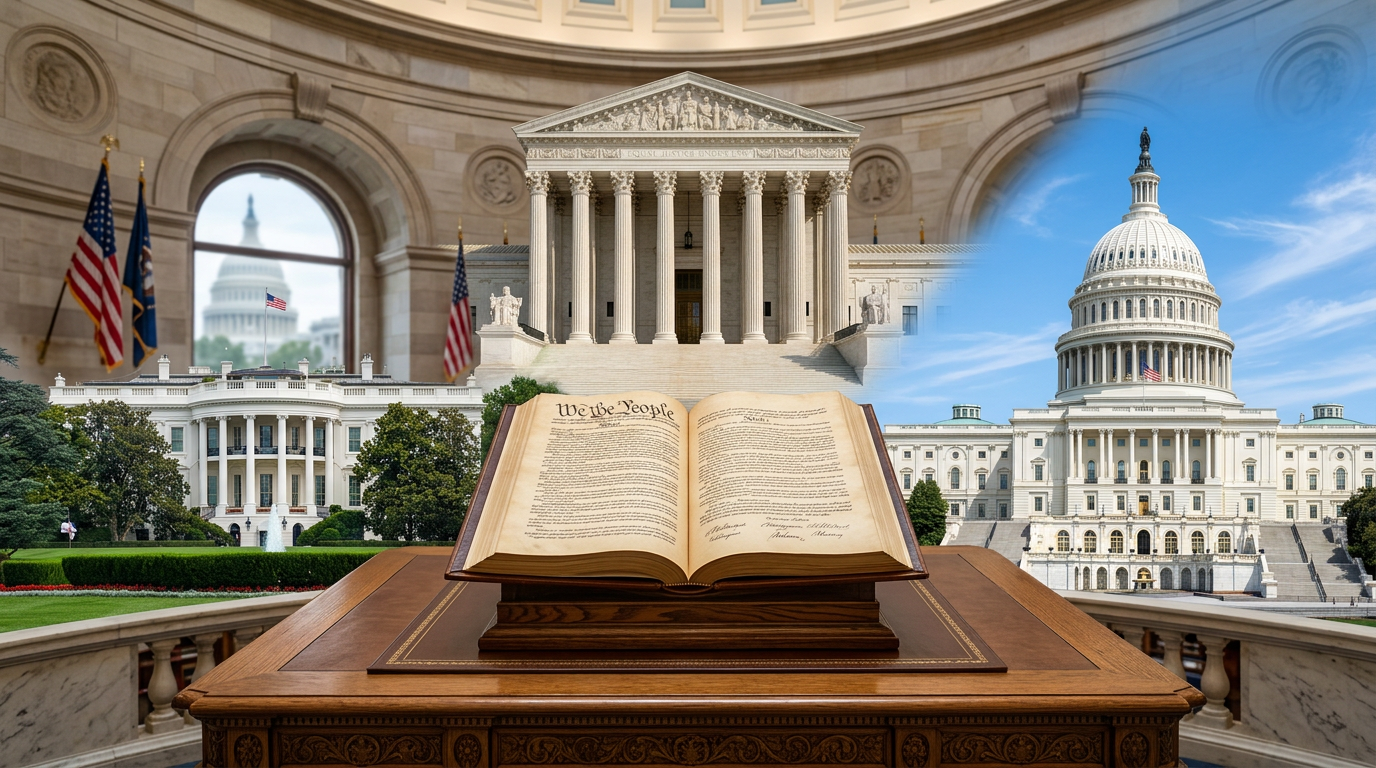
The Constitution does not place one branch permanently above the others. Instead, it creates a system in which Congress writes laws, the president executes them, courts interpret them, and each branch possesses tools that can restrain the others.
Americans often talk about the federal government as though one institution must ultimately be in charge.
Congress passes a law.
The president challenges it.
A federal court blocks the president.
The Supreme Court reverses the lower court.
Congress then considers changing the law.
That naturally raises a question:
Who really has the final say?
Is it Congress because Congress writes the laws?
Is it the president because the president runs the executive branch and enforces those laws?
Or is it the Supreme Court because courts can declare laws and executive actions unconstitutional?
The answer is more complicated than choosing one of the three.
The Constitution deliberately divides federal power among separate institutions. Article I creates Congress. Article II creates the presidency. Article III creates the federal judiciary. The National Archives describes this arrangement as a system of separated powers and checks and balances intended to prevent any one branch from becoming dominant. National Archives — What Does the Constitution Say?
That means the American system does not normally operate according to a simple hierarchy in which one branch gives orders to the other two.
Instead, each branch is supreme in some areas, constrained in others, and dependent upon the others in important ways.
The more accurate question is therefore not:
Which branch is the most powerful?
It is:
Which branch has constitutional authority over the particular question being decided?
The Constitution Divides Power Before It Limits It
The first three articles of the Constitution establish the basic structure.
Article I provides that the legislative powers granted by the Constitution are vested in Congress.
Article II vests executive power in the president.
Article III vests the judicial power of the United States in one Supreme Court and in lower federal courts Congress may establish.
Those are different types of power.
Congress generally makes federal law.
The president executes federal law.
The judiciary resolves cases and controversies arising under the Constitution and laws of the United States.
That sounds straightforward.
In practice, the boundaries overlap.
The president participates in legislation through the veto.
The Senate participates in executive and judicial appointments.
The courts interpret statutes written by Congress.
Congress determines much of the structure and jurisdiction of the federal judiciary.
The president nominates Supreme Court justices.
The Senate confirms them.
Congress can impeach federal judges and executive officials.
The courts may declare actions by Congress or the executive unconstitutional.
That overlapping structure is not accidental.
James Madison explained in Federalist No. 51 that constitutional government required institutions to possess the means and motives to resist encroachments by the others. Federalist No. 51 — Library of Congress
The Constitution therefore does not merely divide power.
It makes the branches compete over power.
Congress Has Enormous Authority
Congress is sometimes portrayed as the weakest branch because modern political attention focuses so heavily on presidents and Supreme Court decisions.
Constitutionally, that is misleading.
Congress possesses extraordinary powers.
It writes federal statutes.
It raises revenue.
It controls federal spending.
It regulates interstate and foreign commerce.
It creates lower federal courts.
It establishes executive departments and agencies by statute.
It raises and supports the military.
It may declare war.
The Senate confirms major executive officials and federal judges.
The House has the power of impeachment, while the Senate conducts impeachment trials.
Congress can also override a presidential veto with the constitutionally required two-thirds vote in both chambers.
Those powers make Congress central to the constitutional system.
A president cannot ordinarily spend money Congress has not appropriated.
A federal agency cannot lawfully exercise powers Congress has never given it unless the Constitution independently supplies them.
And a Supreme Court cannot simply enact a new federal statute because the justices believe Congress should have done so.
In those areas, Congress has the constitutional initiative.
But Congress is not sovereign.
Its laws must comply with the Constitution.
That is where judicial review enters the picture.
The Supreme Court Can Declare Acts of Congress Unconstitutional
The Constitution does not contain a sentence saying:
“The Supreme Court may strike down unconstitutional laws.”
Yet judicial review became an established feature of American constitutional law very early in the republic.
The landmark case is Marbury v. Madison, decided in 1803.
Chief Justice John Marshall reasoned that courts must apply the Constitution when a statute conflicts with it. Because the Constitution is superior law, an ordinary statute inconsistent with the Constitution cannot control the case.
The Supreme Court describes Marbury as the decision that firmly established the Court’s responsibility to invalidate legislation inconsistent with the Constitution. Supreme Court — The Court and Constitutional Interpretation
Interestingly, Marbury itself did not involve the Court dramatically defeating Congress and the president at the same time.
Instead, the Court concluded that Congress had attempted to give the Supreme Court jurisdiction beyond what Article III allowed.
The Court therefore invalidated a statutory provision that purported to expand the Court’s own authority.
That is an important historical detail.
Judicial review was established in a case in which the Court actually limited itself.
Does That Make the Supreme Court Supreme Over Congress?
Not exactly.
The Court can determine that a law cannot constitutionally be enforced in a case before it.
But Congress still possesses substantial powers over the judiciary.
Article III requires the existence of one Supreme Court, but the Constitution leaves important structural questions to Congress.
Congress determines the number of justices by statute.
The Constitution does not specify nine.
Congress has changed the size of the Court several times in American history, with the current number of nine dating to legislation enacted in 1869. Constitution Annotated — Supreme Court and Congress
Congress also creates and structures the lower federal courts.
Indeed, Article III says the judicial power shall be vested in one Supreme Court and whatever inferior courts Congress may establish.
Congress therefore cannot abolish the Supreme Court, but it has broad authority over lower federal courts. Constitution Annotated — Congressional Power to Abolish Federal Courts
Congress also controls judicial funding and may impeach federal judges.
So while the judiciary can invalidate congressional laws, Congress possesses meaningful constitutional tools affecting the judiciary.
That is checks and balances in action.
Congress Can Sometimes Change the Law After Losing in Court
Another misunderstanding is that once the Supreme Court rules, Congress can never respond.
That is not true.
Sometimes the Supreme Court interprets a statute, rather than declaring what the Constitution itself requires.
When that happens, Congress may often respond by rewriting the statute.
Suppose the Court concludes:
“The statute Congress enacted does not authorize this government action.”
Congress may then enact a new statute expressly granting that authority, provided the new law itself complies with the Constitution.
That differs from a case in which the Court says:
“The Constitution prohibits government from doing this.”
Congress cannot overcome a constitutional ruling merely by passing the same unconstitutional law again.
It would need another constitutional path.
That could include changing the underlying law in a way that satisfies the constitutional problem—or, in extraordinary circumstances, pursuing a constitutional amendment.
Congress Can Amend the Constitution—but Not Alone
Here Congress possesses one of the most significant powers in the entire system.
Article V establishes a process for changing the Constitution itself.
Congress may propose a constitutional amendment with a two-thirds vote in both the House and Senate.
But Congress cannot ratify the amendment by itself.
Three-fourths of the states must approve it.
Alternatively, amendments may be proposed through a convention called upon application of two-thirds of state legislatures, although every amendment adopted so far has been proposed by Congress.
The president does not sign constitutional amendments.
The National Archives confirms that the president has no constitutional role in approving an Article V amendment. National Archives — Constitutional Amendment Process
That produces an extraordinary result.
If the Supreme Court interprets the Constitution in a way the country ultimately rejects strongly enough, the Constitution itself can be amended.
An amendment, once validly ratified, changes the constitutional rule the courts must follow.
That means the Supreme Court cannot permanently place its interpretation above the Constitution itself.
The Constitution remains superior to the Court.
The President Has a Different Kind of Power
The president does not normally decide what federal law should say.
The president’s core constitutional responsibility is to execute the law.
Article II requires the president to “take Care that the Laws be faithfully executed.”
That gives the executive branch enormous practical importance.
The president commands the executive departments responsible for enforcing federal law.
The Department of Justice prosecutes federal crimes.
Executive agencies administer federal programs.
The military operates under presidential command subject to constitutional and statutory limits.
Federal officers carry out judgments, regulations, immigration decisions, law-enforcement actions, and countless other governmental functions.
This creates a practical reality:
Courts issue judgments, but courts usually do not possess their own enforcement machinery.
The judiciary depends in substantial measure upon executive officials complying with lawful court orders.
That dependency sometimes causes people to ask whether a president could simply ignore the Supreme Court.
Constitutionally, that question has a much clearer answer than politically provocative rhetoric sometimes suggests.
Can the President Ignore the Supreme Court?
A president does not possess a general constitutional power to disregard binding federal court judgments merely because the president believes the court is wrong.
Article III gives federal courts judicial authority over cases within their jurisdiction.
Final judgments are exercises of that judicial power.
The Supreme Court has held that neither Congress nor the executive may simply reopen final Article III judgments because they dislike the outcome. Constitution Annotated — Reopening Final Judicial Decisions
That principle matters.
If presidents could decide for themselves whether to obey judgments against them, judicial review would become largely meaningless.
A president could lose in court and then simply announce:
“I disagree, so I will proceed anyway.”
That would transform judicial authority into advice.
But an important distinction should be maintained.
Presidents, members of Congress, and citizens remain free to criticize Supreme Court reasoning.
A president may argue that a precedent should be reconsidered.
Congress may change underlying statutes.
Litigants may bring future cases asking courts to distinguish or overturn precedent.
Constitutional disagreement does not end simply because the Supreme Court has spoken.
But criticism of a ruling and refusal to comply with a binding judgment are different things.
Does the Supreme Court Have the Final Word on the Meaning of the Constitution?
This is where the question becomes more intellectually complicated.
In the American legal system, the Supreme Court generally has the final judicial word in cases properly before it.
There is no higher American court to which a losing party can appeal a Supreme Court decision.
For litigation, that is enormously significant.
But scholars and political leaders have long debated whether that means the Supreme Court possesses an exclusive monopoly over constitutional interpretation.
One view, often associated with judicial supremacy, emphasizes that constitutional disputes require an authoritative judicial resolution and that Supreme Court interpretations bind lower courts and government officials within the legal system.
Another view, often called departmentalism, argues that each branch has an independent duty to interpret the Constitution while performing its own constitutional functions.
Under that view, the president should consider constitutionality before signing or enforcing legislation.
Members of Congress should consider constitutionality before voting.
The judiciary should consider constitutionality when deciding cases.
That does not necessarily mean branches may ignore binding judgments against them.
Rather, it means constitutional interpretation is not intellectually performed only by judges.
This distinction is important.
The president takes an oath to preserve, protect, and defend the Constitution.
Members of Congress swear to support the Constitution.
Federal judges do the same.
Every branch therefore has a constitutional responsibility of its own.
Abraham Lincoln Challenged an Unlimited View of Judicial Supremacy
One of the most famous historical examples came from Abraham Lincoln.
Lincoln strongly opposed the Supreme Court’s 1857 decision in Dred Scott v. Sandford.
He did not argue that parties to the case could simply ignore the judgment.
But he rejected the idea that one Supreme Court decision permanently settled the constitutional question for every branch of government and the entire country.
That debate illustrates an enduring distinction:
A judicial judgment resolves the case.
A judicial precedent influences future cases and governmental conduct.
But constitutional meaning may continue to be debated politically, legally, and historically.
Indeed, the Constitution has sometimes been amended precisely because the country rejected constitutional rules produced by previous institutions.
The Supreme Court Itself Is Bound by the Constitution
The Supreme Court cannot simply claim whatever authority it wants.
Article III defines its jurisdiction.
The Court’s original jurisdiction applies to a limited group of cases.
Its appellate jurisdiction exists subject to certain exceptions and regulations Congress may establish. Constitution Annotated — Overview of Supreme Court Jurisdiction
Congress has significant authority under the Exceptions Clause to regulate the Court’s appellate jurisdiction.
According to the Congressional Research Service, Supreme Court precedents recognize broad congressional power in this area, although that power itself remains subject to constitutional limits. Constitution Annotated — Exceptions Clause
Congress cannot, for example, simply dictate how a court must rule in a particular case while pretending to enact ordinary legislation.
Nor can Congress force Article III courts to reopen final judgments merely because legislators dislike them.
Congress has substantial power over courts.
It does not possess the judicial power itself.
Again, neither branch is absolute.
Can Congress Strip the Supreme Court of Jurisdiction?
Sometimes.
But the issue is complicated.
Article III states that the Supreme Court’s appellate jurisdiction exists “with such Exceptions, and under such Regulations as the Congress shall make.”
That text gives Congress substantial authority to regulate appellate jurisdiction.
Congress has historically altered federal jurisdiction, and courts have recognized significant congressional authority in this area.
But this does not necessarily mean Congress can use jurisdictional statutes to accomplish anything it wants.
Other constitutional provisions still matter.
Congress cannot abolish the Supreme Court.
It cannot eliminate constitutionally granted original jurisdiction.
And jurisdiction-stripping proposals can raise difficult separation-of-powers and constitutional-rights questions depending on how they are constructed.
So here too, the answer is not:
Congress controls the Court.
It is:
Congress possesses important constitutional authority over the federal judiciary, but that authority itself has constitutional boundaries.
Can Congress Change the Number of Supreme Court Justices?
Yes, historically it has.
The Constitution establishes “one supreme Court” but does not state how many justices must sit on it.
Congress has changed the Court’s size multiple times.
The current nine-member Court dates to 1869.
That means proposals to expand or reduce the Court raise important political and institutional questions, but the number nine is not itself specified in the Constitution.
President Franklin Roosevelt famously proposed expanding the Court in 1937 after repeated judicial opposition to New Deal programs.
Congress rejected the proposal.
The episode demonstrates an important point.
Congress may possess a constitutional power while still choosing not to exercise it because lawmakers believe its use would damage another constitutional value, such as judicial independence.
Constitutional authority and institutional wisdom are not always the same question.
Can Congress Remove Supreme Court Justices?
Not simply because Congress dislikes their decisions.
Article III provides that federal judges hold office during “good Behaviour.”
Federal judges therefore do not serve at the pleasure of Congress or the president.
But judges can be removed through impeachment.
The House may impeach.
The Senate conducts the trial.
The Congressional Research Service describes impeachment as an important legislative check on both executive and judicial officers. Constitution Annotated — Impeachment
The existence of impeachment does not mean Congress is constitutionally entitled to remove judges simply because legislators disagree with their constitutional interpretation.
Judicial independence would mean very little if judges could be removed whenever they issued politically unpopular decisions.
The President Also Checks the Court Before Justices Ever Take Office
Supreme Court justices do not select their own successors.
The president nominates federal judges.
The Senate provides advice and consent.
That means the elected branches influence the long-term direction of constitutional law through appointments.
But once confirmed, Article III judges receive protections intended to give them independence from the officials who appointed them.
A president therefore influences the Court but does not command it.
A justice nominated by a president does not become that president’s subordinate.
That distinction is central to judicial independence.
Congress Checks the President
Just as Congress has tools affecting the judiciary, it possesses powerful checks on the president.
Congress controls appropriations.
Congress writes the statutes executive agencies administer.
The Senate confirms nominees.
Congress may conduct investigations and oversight.
Congress can override presidential vetoes.
And Congress may impeach and remove a president under the constitutional process.
The president is therefore powerful but not constitutionally sovereign.
Even the Commander in Chief operates alongside congressional powers over military funding, regulation, and war.
A constitutional system in which Congress actually exercises these powers can meaningfully restrain executive authority.
But a practical problem arises when partisan loyalty overrides institutional loyalty.
Members of Congress may defend presidential powers when their own party controls the White House and rediscover congressional authority when the opposing party takes control.
That behavior can shift the practical balance of power even when the Constitution’s words remain unchanged.
The President Checks Congress Too
The relationship works in the other direction.
Congress may pass legislation, but the president may veto it.
Congress can override the veto—but only by assembling the constitutionally required supermajority.
That requirement gives the president substantial influence over legislation.
The executive branch also administers the laws Congress writes.
Because statutes cannot anticipate every possible factual circumstance, presidents and executive agencies often exercise significant discretion in implementation.
This means the line between executing law and effectively making policy can become contentious.
Congress may respond by amending statutes, restricting funding, conducting oversight, or challenging executive interpretations.
Courts may eventually become involved.
Again, the system does not ask one branch to permanently dominate.
It forces interaction.
The Supreme Court Checks the President
Federal courts can determine whether executive actions exceed statutory or constitutional authority.
That can include executive orders, agency actions, military-related disputes, immigration policies, regulatory decisions, and other exercises of governmental authority.
But courts cannot simply substitute their policy preferences for executive decisions whenever judges disagree with them.
Federal courts decide legal cases and controversies.
They do not possess general executive authority.
That distinction matters because constitutional checks do not make each branch interchangeable.
The judiciary can say:
“The executive lacks legal authority to do this.”
That does not mean judges then become the executive officials responsible for designing and administering the replacement policy.
No Branch Has the Last Word on Everything
This brings us back to the central question.
Who has the final say?
On what a federal statute should say?
Usually Congress, subject to presidential participation through the veto process and subject to constitutional limitations.
On whether to sign or veto legislation?
The president, although Congress can override a veto.
On how executive authority should be exercised within the law?
Primarily the president and executive branch, subject to statutes and constitutional limitations.
On the outcome of a particular constitutional case properly before the federal judiciary?
Ultimately the Supreme Court, if it hears the case.
On whether a federal statute violates the Constitution?
Courts exercise judicial review, with the Supreme Court ordinarily providing the final judicial interpretation.
On changing the Constitution itself?
No single branch.
Article V requires an extraordinary national consensus involving Congress or the states in the proposal process and three-fourths of the states for ratification.
That may be the most important answer of all.
The Constitution—not Congress, not the president, and not the Supreme Court—is supposed to be supreme.
But Who Enforces That Principle?
Ultimately, institutions do.
And so do people.
The Constitution is not self-enforcing.
A president must respect lawful judicial judgments.
Congress must respect judicial independence.
Courts must remain within the judicial role.
Executive officials must follow lawful statutes.
Members of Congress must defend legislative powers even when a president from their own party would prefer fewer restraints.
Judges must distinguish constitutional interpretation from personal policy preference.
Voters must resist the temptation to judge constitutional powers entirely according to whether those powers produce their preferred political result.
No system of written rules can completely prevent officials from abusing authority.
The Framers understood that.
That is why the Constitution does not rely on goodwill alone.
It gives institutions the ability to resist one another.
The Strongest Argument for Judicial Supremacy
There is a powerful argument for giving Supreme Court constitutional interpretations extraordinary authority.
A nation governed by written law requires some institution capable of resolving legal disputes conclusively.
If every state, president, federal agency, and congressional majority could decide independently whether a Supreme Court ruling should be obeyed, constitutional rights could vary according to political convenience.
Judicial independence helps protect constitutional rules from temporary political majorities.
Lifetime tenure during good behavior and protection against salary reduction help insulate federal judges from immediate electoral pressure.
From this perspective, meaningful constitutional government requires courts whose judgments cannot simply be discarded by the political branches.
Without that principle, rights could become dependent on whether elected officials felt like respecting them.
That is a serious argument.
The Strongest Argument Against Unlimited Judicial Supremacy
There is also a serious counterargument.
Supreme Court justices are unelected and ordinarily serve for decades.
The Constitution never expressly says that nine judges possess exclusive authority to determine constitutional meaning for every branch in every circumstance.
The Court has issued decisions throughout American history that later generations regarded as profoundly wrong.
Dred Scott v. Sandford is one obvious example.
So is Plessy v. Ferguson, which upheld racial segregation before being repudiated decades later.
Judicial review therefore does not mean judicial infallibility.
The Court can interpret the Constitution incorrectly.
It can reverse its own precedents.
Constitutional amendments can change the governing rule.
Congress can alter statutes underlying judicial decisions.
Presidents and legislators may continue arguing that existing precedent should be reconsidered.
From this perspective, treating the Court as the only institution capable of thinking constitutionally may improperly diminish the constitutional responsibilities of elected officials and citizens.
That argument also deserves serious consideration.
The Better Way to Think About “Final Say”
The phrase “final say” may itself be misleading.
American government is less like a corporate organization with a chief executive at the top and more like a constitutional competition among institutions exercising different powers.
A Supreme Court ruling may be final in a particular lawsuit.
Congress may then change the underlying statute.
The executive may implement the ruling while arguing for a different interpretation in a future case.
A later Supreme Court may reverse precedent.
The country may amend the Constitution.
That does not mean constitutional law is meaningless.
It means constitutional government operates through institutions over time.
The Constitution creates temporary finality in particular places without granting permanent omnipotence to any single branch.
The Most Important Example: The Constitution Can Overrule Everyone
Imagine that Congress passes a law.
The president signs it.
The Supreme Court later concludes that the Constitution prohibits that law.
At that moment, the Court’s judgment controls the case and the law cannot constitutionally operate in the way the Court rejected.
But suppose an overwhelming national consensus develops that the Court’s constitutional interpretation is wrong.
The people, acting through Article V’s demanding amendment process, can change the Constitution itself.
Once the amendment becomes part of the Constitution, Congress, the president, and the courts must follow the new constitutional rule.
That tells us where sovereignty ultimately rests in the American constitutional theory.
Not permanently with Congress.
Not with the president.
Not even with the Supreme Court.
The government itself is subordinate to the Constitution.
And the Constitution begins with three words:
“We the People.”
The Founding Standard Assessment
The question “Who has the final say?” has no single answer because the Constitution deliberately refuses to give one institution final authority over every governmental question.
Congress possesses legislative power.
The president possesses executive power.
The judiciary possesses judicial power.
Each branch can check the others, but each check has limits.
The Supreme Court possesses the final judicial authority in cases that reach it and has exercised judicial review since Marbury v. Madison. That gives the Court extraordinary influence over constitutional meaning.
But the Court is not constitutionally omnipotent.
Congress structures much of the federal judiciary, determines the number of Supreme Court justices, possesses substantial authority over federal jurisdiction, controls appropriations, and may impeach federal judges.
The president cannot ordinarily disregard binding judicial judgments, but the president has an independent constitutional responsibility to interpret and obey the Constitution while exercising executive power.
Congress cannot simply overturn a constitutional judgment with an ordinary statute, but it can change statutory law and participate in proposing constitutional amendments.
And the Supreme Court cannot amend the Constitution.
That power ultimately belongs to the constitutional process established by Article V.
The best answer, therefore, is not that Congress, the president, or the Supreme Court always has the final say.
The Constitution has the final say.
The branches are institutions entrusted with different responsibilities for interpreting, applying, enforcing, and sometimes changing the legal framework beneath it.
That arrangement can be frustrating.
It can create conflict.
It can produce gridlock.
And it sometimes produces constitutional crises when institutions fundamentally disagree.
But that friction is not necessarily evidence that the American system has failed.
It is often evidence that no single branch has succeeded in becoming the government itself.
And that was the point.
Sources and Further Reading
Foundational Constitutional Sources
U.S. Constitution — National Archives
Primary text of the Constitution, including Articles I, II, III, V, and VI.
The Constitution: What Does It Say? — National Archives
National Archives overview of the three branches, separation of powers, checks and balances, federal supremacy, and the amendment process.
Federalist No. 51 — James Madison, Library of Congress
Madison’s explanation of checks and balances and why government institutions must be capable of resisting encroachments by one another.
Federalist No. 78 — Alexander Hamilton, Library of Congress
Hamilton’s influential defense of an independent judiciary and judicial review.
Judicial Review and the Supreme Court
The Court and Constitutional Interpretation — U.S. Supreme Court
Supreme Court overview of constitutional interpretation and the development of judicial review through Marbury v. Madison.
Marbury v. Madison — U.S. Supreme Court Background
Supreme Court historical discussion of Marbury and the establishment of judicial review.
Overview of Supreme Court Jurisdiction — Constitution Annotated
Congressional Research Service explanation of the Supreme Court’s original and appellate jurisdiction under Article III.
Exceptions Clause and Congressional Control Over Appellate Jurisdiction — Constitution Annotated
Analysis of Congress’s authority to regulate the Supreme Court’s appellate jurisdiction and the constitutional limitations surrounding that power.
Congress and the Judiciary
Supreme Court and Congress — Constitution Annotated
Discussion of Congress’s authority over the size, structure, sessions, and jurisdiction of the Supreme Court.
Overview of Congressional Control Over Judicial Power — Constitution Annotated
Congressional Research Service analysis of Congress’s significant but constitutionally limited authority over the federal judiciary.
Congressional Power to Abolish Federal Courts — Constitution Annotated
Explains why Congress cannot abolish the Supreme Court but possesses broad authority concerning lower federal courts.
Reopening Final Judicial Decisions — Constitution Annotated
Explains the constitutional protection of final Article III judgments from legislative or executive revision.
Impeachment and Institutional Checks
Overview of the Impeachment Clause — Constitution Annotated
Congressional Research Service discussion of impeachment as a constitutional check on executive and judicial officers.
Constitutional Amendment
Constitutional Amendment Process — National Archives
Official explanation of Article V, including proposal by Congress or convention, ratification by three-fourths of the states, and the fact that the president does not approve constitutional amendments.
Article Type: Constitutional Analysis
Primary Category: Constitution
Secondary Category: Civic Responsibility
Published: August 2026
Review Date: August 2027