
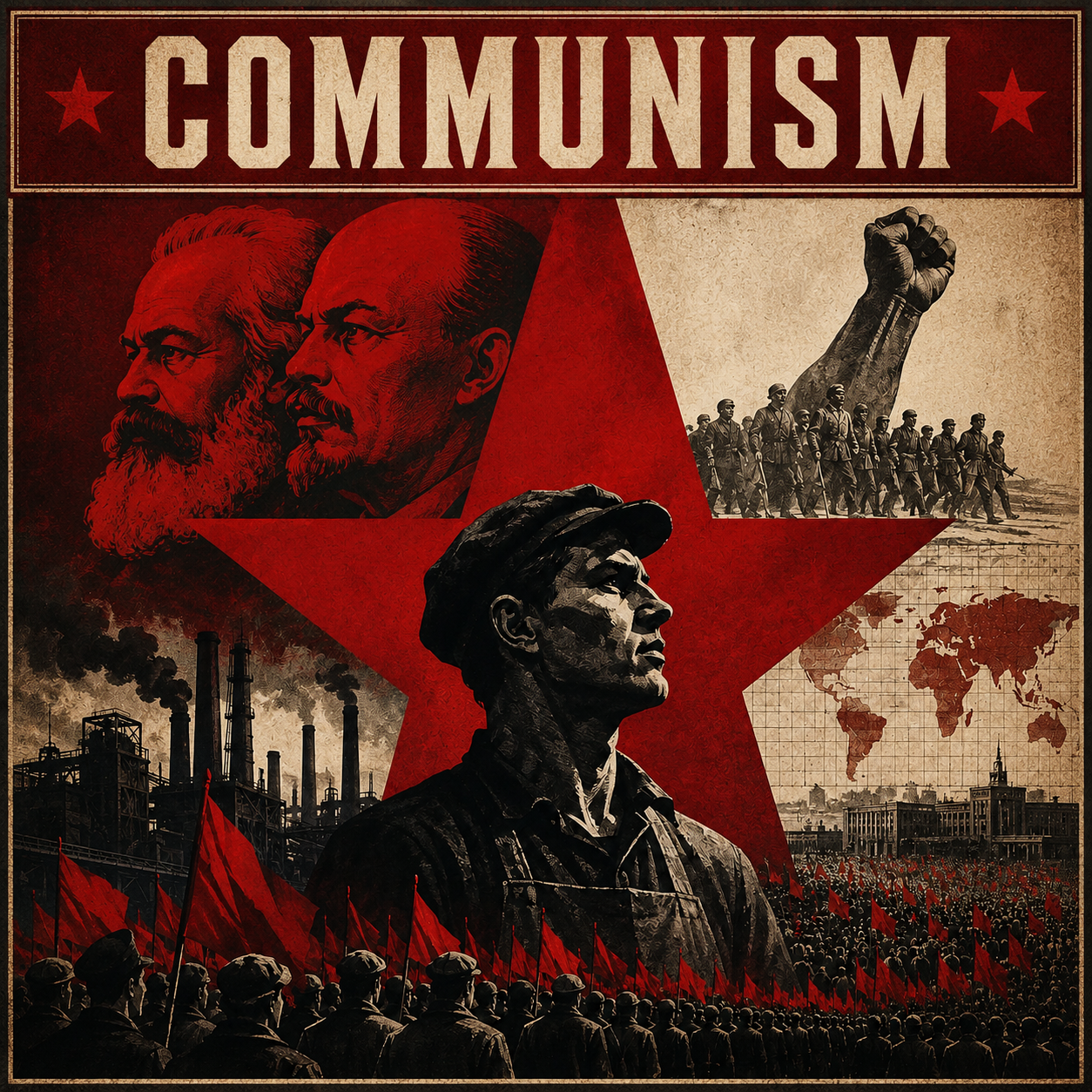
Communism is one of the most influential and destructive political forces in modern history—and one of the most disputed.
Its supporters have described it as a movement to abolish exploitation, class domination, economic inequality, and private control over society’s productive resources.
Its critics associate it with revolutionary violence, one-party government, censorship, forced collectivization, political imprisonment, chronic shortages, and the concentration of nearly unlimited power in the state.
Both descriptions concern real parts of communism’s history.
Communism began as a revolutionary theory of human liberation. It inspired movements seeking to overthrow monarchies, empires, colonial systems, landed elites, and capitalist ownership.
In several countries, communist movements helped mobilize workers, expand literacy, industrialize poor societies, resist foreign domination, and provide broader access to education, health care, or employment.
Communist governments also repeatedly suppressed political opposition, eliminated independent institutions, restricted religion and speech, controlled economic life, and punished people identified as class enemies or ideological threats.
A responsible examination should neither reduce communism to its promises nor treat every person attracted to its ideals as an advocate of dictatorship.
It should ask what communist thinkers proposed, what communist movements created, why those systems developed as they did, and whether their recurring outcomes were accidental distortions or consequences of the ideology’s political structure.
A Basic Definition
Communism is a revolutionary political and economic tradition seeking the abolition of social classes and private ownership of major productive resources.
In the communist ideal, productive property would be held in common, economic exploitation would disappear, and goods would eventually be distributed according to human need rather than private profit or market purchasing power.
Communism belongs to the broader socialist tradition, but it is more specific.
Socialism includes democratic, reformist, cooperative, market-oriented, libertarian, religious, and revolutionary movements. Communism became especially associated with Marxist revolutionary politics, the overthrow of capitalism, the political rule of the working class, and the eventual creation of a classless society.
The United States Holocaust Memorial Museum describes communism as an ideology seeking a classless society in which private property and profit-based economic organization are replaced by public ownership and communal control of the major means of production.
Communism and Property
One of the most common misunderstandings is that communism means abolishing every form of personal possession.
Marx and Engels focused primarily on what they called bourgeois property: privately owned productive capital that allows one class to control production and employ another.
In The Communist Manifesto, they wrote that communists sought the abolition of bourgeois private property, not the elimination of personal use of ordinary goods in every sense. They argued that capitalist property enabled owners to command labor and accumulate wealth from production performed by workers.
The practical distinction is between:
- Personal possessions used in everyday life
- Productive assets used to generate income or control economic production
Communist movements have differed over where that line should be drawn.
Historically, communist governments often nationalized factories, banks, transportation, foreign trade, commercial property, and large-scale agriculture. Some also restricted small business, private farming, inheritance, or independent professional activity.
The question is therefore not whether communists intend to confiscate every coat or household object. It is how much independent economic ownership would remain and whether people could operate businesses or employ labor outside state control.
Marx and Engels
Karl Marx and Friedrich Engels provided the intellectual foundation for most modern communist movements.
Their theory combined philosophy, economics, history, and revolutionary politics.
Marx argued that economic systems shape social classes and political institutions. He viewed history substantially as a struggle between groups positioned differently within systems of production.
Under capitalism, the central division was between:
- The bourgeoisie, who owned productive capital
- The proletariat, who survived primarily by selling their labor
Marx argued that capitalism had created extraordinary productive wealth while also creating exploitation, recurring crises, insecurity, and the concentration of ownership.
In his account, workers produced economic value but did not control the enterprise, the product, or the conditions under which they labored.
Marx predicted that capitalism’s internal conflicts would intensify and eventually produce revolutionary transformation. Yet he provided relatively little detail about the exact institutions of a future communist society. The Stanford Encyclopedia of Philosophy notes that Marx deliberately avoided offering a comprehensive blueprint for that future order.
That lack of institutional detail became enormously important.
Later revolutionaries had to decide how a communist transition would actually work, who would rule, how dissent would be treated, how production would be managed, and when—or whether—the transitional state would surrender power.
The Communist Ideal
In classical Marxist theory, communism is the final stage of social development.
It would be:
- Classless
- Based on common ownership
- Free from capitalist exploitation
- Capable of meeting human needs abundantly
- Organized around cooperative rather than competitive production
- Free from the coercive political state as it had previously existed
The eventual disappearance of the state is central to the ideal.
Marxists argued that the state historically served class domination. Once classes disappeared, the coercive machinery needed to enforce one class’s rule over another would no longer be necessary.
This vision separates communism’s theoretical endpoint from the highly centralized states that later called themselves communist.
Supporters argue that countries such as the Soviet Union never reached communism. They remained transitional socialist states under difficult historical conditions.
Critics respond that a system requiring an enormously powerful transitional state has no reliable mechanism for ensuring that those controlling it will voluntarily surrender their authority.
Revolution and the Working Class
Marx and Engels did not view communism as simply a welfare policy to be adopted within capitalism.
They described it as a revolutionary transformation of ownership and political power.
In The Communist Manifesto, they stated that communists sought the formation of the proletariat into a political class, the overthrow of bourgeois supremacy, and the conquest of political power by workers.
The meaning of revolution varied among later Marxists.
Some socialist parties pursued elections and gradual reform. Others concluded that capitalist governments would never permit their own peaceful replacement and that revolutionary force was therefore necessary.
This division helped separate revolutionary communism from democratic socialism and social democracy.
Communist revolutionaries generally argued that existing constitutions, courts, property rights, police, militaries, and legislatures protected capitalist class power. They therefore did not necessarily view those institutions as neutral rules to be preserved.
They sought to replace the existing political order, not simply win office within it.
Lenin and the Vanguard Party
Vladimir Lenin reshaped Marxism into the political model that most strongly influenced twentieth-century communist governments.
Lenin argued that workers would not automatically develop revolutionary consciousness simply through ordinary economic struggle.
A disciplined revolutionary party was needed to organize, educate, and lead them.
This became the idea of the vanguard party.
The party would:
- Develop revolutionary theory
- Organize professional activists
- Coordinate political struggle
- Seize state power
- Defeat counterrevolution
- Direct the transition toward socialism
Lenin also defended what Marxists called the dictatorship of the proletariat: political rule by the working class during the transition from capitalism.
In The State and Revolution, Lenin described this period as requiring undivided revolutionary power backed by the armed force of the people, while also maintaining that the state would eventually disappear after class antagonisms ended.
In practice, the revolutionary party claimed to represent the working class.
This created a critical institutional question:
What happens when workers, voters, unions, local councils, or rival socialist parties disagree with the party claiming to speak for them?
In communist states, the answer was frequently that the ruling party possessed superior historical and ideological legitimacy.
Opposition could then be treated not as ordinary political disagreement, but as counterrevolution.
The Russian Revolution
The first durable communist government emerged from the Russian Revolution of 1917.
Russia experienced the collapse of the imperial government, war, economic crisis, military breakdown, and political conflict.
The Bolsheviks, led by Lenin, overthrew the Provisional Government during the October Revolution and established a new revolutionary government. The United States Holocaust Memorial Museum describes the Bolshevik Revolution as the first successful Marxist seizure of state power.
The revolution was followed by civil war, foreign intervention, famine, economic disruption, and violent conflict between competing forces.
The Bolsheviks defended harsh emergency policies as necessary for survival.
They also restricted opposition parties, suppressed independent political activity, and established institutions of coercion that remained after the immediate emergency.
The Soviet Union was formally created in 1922 and became the model for many later communist movements.
Marxism-Leninism
After Lenin’s death, Soviet ideology became known as Marxism-Leninism.
It combined Marx’s theory of class struggle and revolutionary transformation with Lenin’s vanguard party, centralized authority, and theory of imperialism.
Marxism-Leninism generally supported:
- One ruling communist party
- State control of major productive property
- Central economic planning
- Political leadership by the party
- Suppression of organized counterrevolution
- International support for communist movements
- Ideological education
- A transitional socialist state claiming to move toward communism
This model spread through Eastern Europe, China, North Korea, Vietnam, Cuba, and other states or revolutionary movements, although each developed distinct national features.
The Soviet Communist Party also supported or influenced foreign communist parties as instruments of international strategy. Records opened after the Soviet collapse revealed substantial political and financial ties between Moscow and communist organizations abroad.
Stalinism
Joseph Stalin transformed the Soviet Union through forced industrialization, agricultural collectivization, strict party control, mass political repression, and a powerful security apparatus.
The Soviet government sought to replace private farming with large collective and state farms and to direct economic production through centralized plans.
These policies helped build heavy industry and military capacity.
They also caused enormous human suffering through coercion, displacement, hunger, imprisonment, executions, and the destruction of independent rural life.
Library of Congress archival material describes the expansion of party-state control under Stalin, mass deportation associated with collectivization, political terror, suppression of local initiative, and the restructuring of cultural institutions to enforce ideological conformity.
The Soviet labor-camp system, known as the Gulag, held millions of political and criminal prisoners and became an instrument of punishment, forced labor, and social terror.
Communists themselves have disagreed sharply over Stalin.
Some defended his industrialization and leadership during the Soviet struggle against Nazi Germany.
Others regarded Stalinism as a bureaucratic, dictatorial betrayal of socialism.
Critics argue that Stalin’s system grew from institutions already established under Lenin: one-party rule, suppression of opposition, political policing, and the belief that the party possessed a monopoly on historical truth.
Maoism
Mao Zedong adapted Marxism-Leninism to a largely rural society.
Where classical Marxism focused on the industrial working class, Mao placed greater revolutionary emphasis on peasants.
Maoism stressed:
- Protracted revolutionary struggle
- Peasant mobilization
- Guerrilla warfare
- Continuous class conflict
- Ideological transformation
- Mass political campaigns
- Resistance to bureaucratic or capitalist restoration
The People’s Republic of China was established in 1949 after a prolonged civil war.
China’s communist government redistributed land, nationalized industry, expanded state power, and later launched large-scale campaigns to transform agriculture, production, culture, and political life.
The Chinese experience became influential across Asia, Africa, and Latin America, particularly among movements operating in rural or colonial settings.
Maoism also demonstrated how a revolution claiming to destroy hierarchy could create an intense personality cult and recurring political purges.
Other Communist Traditions
Communism is not limited to Soviet or Chinese models.
Other traditions have included:
- Trotskyism
- Council communism
- Left communism
- Eurocommunism
- Titoism
- Castroism
- Guevarism
- National communism
- Christian communism
- Anarchist communism
Some rejected Stalinism while remaining revolutionary Marxists.
Others criticized the Soviet Union as bureaucratic state capitalism rather than genuine socialism.
Eurocommunist parties attempted to distance themselves from Soviet control and participate more fully in parliamentary democracy.
Anarchist communists rejected centralized state ownership and sought decentralized voluntary communities.
These differences matter.
A fair article should identify the specific communist tradition under examination rather than assume that every communist accepts Stalin, Lenin, Mao, or one-party government.
Central Economic Planning
Communist governments generally replaced large portions of market exchange with central planning.
Government agencies determined:
- Production targets
- Industrial priorities
- Investment
- Prices
- Wages
- Access to materials
- Agricultural procurement
- Foreign trade
- Distribution of many goods
Supporters argued that planning could:
- Eliminate wasteful competition
- Direct resources toward public needs
- Industrialize rapidly
- Guarantee employment
- Build infrastructure
- Provide universal services
- Avoid recessions caused by private investment cycles
Central planning did produce major industrial and military development in some countries.
It also faced recurring problems.
Planners had to make millions of decisions without the decentralized information communicated through changing prices, profits, losses, consumer behavior, and local knowledge.
Enterprises had incentives to satisfy numerical targets rather than actual consumer needs.
Managers could conceal failures, inflate requests, hoard materials, or produce low-quality goods to meet quotas.
Political leaders could direct resources toward prestige, military, or ideological priorities regardless of public preference.
The Strongest Arguments for Communism
Communism attracted support because it addressed genuine injustice.
A fair assessment must present its strongest arguments.
Capitalism Concentrates Economic Power
Communists argue that ownership of productive property gives a relatively small class power over employment, wages, investment, housing, media, and politics.
Formal legal equality may therefore coexist with deep economic domination.
Workers Produce Wealth They Do Not Control
Employees collectively create goods and services, yet owners and investors often control the workplace and receive profits.
Communism proposes common ownership so that production benefits society rather than a private ownership class.
Class Inequality Distorts Democracy
Wealth can purchase political access, advertising, legal expertise, media influence, and institutional control.
Communists argue that meaningful political equality is impossible while economic classes possess radically unequal power.
Markets Distribute by Ability to Pay
Markets respond to purchasing power, not necessarily human need.
A person may desperately need housing, food, or medicine without having the money required to obtain it.
Communists argue that essential goods should be distributed according to need.
Capitalism Produces Instability
Marxists identify recurring crises, unemployment, debt, business failures, and financial speculation as systemic features rather than isolated mistakes.
Communist planning promises rational coordination instead of economic cycles driven by private investment and profit.
Capitalism Alienates Human Labor
Marx argued that workers can become separated from the products they create, the process of labor, their human potential, and one another.
Communism promises work organized cooperatively around social purpose.
International Capitalism Encourages Imperialism
Lenin and later communists argued that capitalist powers seek markets, resources, labor, and strategic control abroad.
Communist movements often connected class revolution with anticolonial and national-liberation struggles.
The Strongest Criticisms of Communism
Communism faces criticisms based not only on theory but on repeated historical experience.
The Party Claims a Monopoly on Truth
A vanguard party may claim special knowledge of history and class interest.
Once it does, opposition can be treated as ignorance, false consciousness, sabotage, or counterrevolution rather than legitimate disagreement.
Political and Economic Power Become Unified
Under private capitalism, economic power can influence government.
Under communist state ownership, the government may directly control employment, housing, media, education, production, credit, and political participation.
A citizen opposing the ruling party may therefore risk nearly every part of life.
No Reliable Mechanism Makes the State Disappear
Communist theory predicts the eventual decline of state coercion.
Historical communist governments instead built powerful bureaucracies, militaries, police agencies, surveillance systems, and party hierarchies.
Those institutions developed their own interests and rarely moved voluntarily toward political self-dissolution.
Central Planning Has Severe Information Problems
No central authority can easily obtain or process all local knowledge about supply, demand, quality, innovation, and consumer preference.
Shortages and surpluses may coexist because official plans are slow to adapt.
Weak Accountability Encourages Failure
When the government owns the enterprise, sets the target, controls the press, and judges its own performance, mistakes can be hidden.
Officials may fear reporting bad results because failure can be interpreted as disloyalty.
Revolutionary Violence Can Become Permanent
Communist movements often justified coercion as temporarily necessary to defeat former ruling classes and external enemies.
The definition of enemy could then expand to include rival socialists, independent workers, farmers resisting collectivization, religious believers, intellectuals, minority groups, or party members accused of deviation.
Individual Rights Become Conditional
If rights are viewed primarily as products of class power, communist governments may reject constitutional protections associated with liberal democracy as bourgeois restraints.
Speech, religion, property, due process, and political opposition may then be subordinated to the revolution.
Was Authoritarianism Inevitable?
This is one of the central disputes.
Communists critical of Soviet-style government argue that authoritarian outcomes resulted from:
- War
- Economic underdevelopment
- Foreign invasion
- International isolation
- Failed leadership
- Stalin’s personality
- Bureaucratic capture
- Abandonment of worker democracy
- Distortion of Marx’s original goals
These factors clearly mattered.
Russia in 1917 was not a wealthy, stable liberal democracy. It was a war-torn former empire with weak institutions, mass poverty, and civil conflict.
Critics nevertheless argue that communist institutional choices also mattered:
- The rejection of pluralist politics
- The elimination of competing parties
- Party control of unions
- Political policing
- State ownership of economic life
- Revolutionary legitimacy above ordinary law
- Censorship
- The treatment of dissent as counterrevolution
Historical context helps explain why coercion occurred.
It does not prove that coercion was unrelated to the system.
Communism and Democracy
Some communist parties have participated in democratic elections.
Others have rejected parliamentary democracy as a system designed to preserve capitalist rule.
A movement’s democratic character should be assessed by asking:
- Can rival parties organize?
- Can communists lose an election and leave office?
- Can the public reject communist policies?
- Is the press independent?
- May workers form unions outside party control?
- Can religious institutions operate independently?
- Are courts independent?
- Can citizens criticize Marxism?
- May businesses or cooperatives exist outside state direction?
- Can people leave the country?
- Are peaceful critics treated as citizens or enemies?
Participation in one election is not sufficient.
A political movement is meaningfully democratic only if it accepts uncertainty, opposition, lawful defeat, and limits upon its own power.
Communism and Religion
Marx viewed religion partly as a response to suffering and alienation, but also as an ideology that could help legitimize existing social conditions.
Many communist governments promoted atheism or sought to reduce the social and political power of religious institutions.
Policies varied.
Some governments allowed limited worship under state supervision. Others closed religious institutions, confiscated property, imprisoned clergy, restricted religious education, or pressured believers to abandon public practice.
Communist movements often viewed independent religious communities as potential rivals because they possessed moral authority, property, networks, and loyalties outside party control.
Not every communist supports religious repression.
Christian communists and other religious socialists have argued that shared ownership and equality are consistent with faith.
The historical record nevertheless demonstrates the danger created when a government possesses authority to define religion as politically reactionary.
Communism and Nationalism
Classical communism was internationalist.
Marx and Engels called upon workers across national borders to unite against shared class domination.
In practice, communist governments frequently became strongly national.
They defended borders, built militaries, celebrated national achievements, and pursued state interests.
Some communist movements fused Marxism with anticolonial nationalism.
Others subordinated national communist parties to Soviet foreign policy.
This tension between international class solidarity and national state power remained unresolved.
Communist governments could denounce nationalism in rivals while using national pride to mobilize their own populations.
Communism’s Claimed Achievements
Communist governments and their defenders point to achievements that should be examined rather than ignored.
Depending on the country and period, these may include:
- Rapid industrialization
- Mass literacy
- Expansion of education
- Broader access to health services
- Employment guarantees
- Scientific and technological development
- Expansion of women’s participation in education and work
- Land redistribution
- Defeat of invading or fascist forces
- Anticolonial resistance
- Infrastructure development
- Reduced formal class privilege
The Soviet Union played a decisive role in the military defeat of Nazi Germany, while suffering extraordinary casualties during the war. Nazi Germany itself described the conflict against the Soviet Union as an ideological and racial war of annihilation.
Acknowledging such achievements does not erase repression.
Likewise, documenting repression does not require denying every improvement that occurred under communist rule.
Historical evaluation should compare the benefits, costs, alternatives, and distribution of burdens.
Communism’s Human Costs
Communist governments produced substantial human costs through different mechanisms.
These included:
- Civil war
- Forced collectivization
- Political executions
- Labor camps
- Famine connected to state policy
- Forced relocation
- Religious persecution
- Border restrictions
- Purges
- Imprisonment of dissidents
- Suppression of uprisings
- State violence against suspected class enemies
Exact totals remain debated because records are incomplete, definitions differ, and political actors may exaggerate or minimize estimates.
Responsible articles should identify the particular country, period, policy, and source rather than repeat one dramatic global number without explanation.
The record is sufficiently serious without careless statistics.
“That Was Not Real Communism”
When discussing communist history, one response appears frequently:
That was not real communism.
The statement can mean several different things.
It may mean:
- The society never reached Marx’s classless final stage.
- Workers did not genuinely control production.
- A bureaucratic elite replaced the capitalist class.
- The state failed to disappear.
- Stalin or another leader betrayed the revolution.
- External pressure forced the system away from its ideals.
Some of those claims have merit.
The Soviet Union was not the stateless, classless society described as the final communist ideal.
But a system should not be evaluated only by its unreachable endpoint.
It must also be evaluated by the transition it requires.
If repeated efforts to build communism produce centralized states, party elites, economic coercion, and restricted dissent, critics are justified in asking whether those outcomes are connected to the means chosen.
A fair standard is:
- Do not define communism only by governments that claimed the label.
- Do not define it so ideally that no real-world evidence can ever count against it.
Communism and the American Constitution
The American constitutional system is fundamentally incompatible with several features historically associated with communist one-party government.
These include:
- Abolition of competitive elections
- Suppression of opposition parties
- Government punishment of political belief
- Censorship
- Elimination of free religious exercise
- Denial of due process
- Uncompensated seizure of private property
- Political control of courts
- Restrictions on peaceful association
The First Amendment protects religion, speech, press, peaceful assembly, and petition.
The Fifth and Fourteenth Amendments protect due process, while the Fifth Amendment also requires just compensation when private property is taken for public use.
The Constitution does not forbid Americans from advocating communism as a political philosophy.
Advocacy, association, and political organizing remain protected, subject to generally applicable laws and established limits concerning criminal conduct, threats, conspiracy, and incitement.
Specific public-ownership or redistribution policies must be evaluated under the relevant constitutional authority and protections.
The important distinction is between:
- Advocating an economic model through lawful democratic procedures
- Abolishing constitutional democracy to impose that model
Common Misconceptions
“Communism and Socialism Are Exactly the Same”
Communism is part of the broader socialist tradition, but many socialists reject revolutionary communism, one-party rule, Leninism, and centralized planning.
“Communism Means Sharing”
Voluntary sharing is not a complete political economy.
Communism concerns ownership, class structure, state power, production, and distribution.
“Communism Abolishes Every Personal Possession”
Classical communist theory focused primarily on productive property and capital, although historical governments often imposed broader economic controls.
“Every Communist Supports Stalin”
Communists have included Stalinists, Trotskyists, Maoists, democratic communists, council communists, anarchist communists, and many others who strongly disagree.
“Every Government Service Is Communist”
Courts, roads, public schools, military forces, pensions, and public utilities can exist in capitalist, socialist, or mixed economies.
“Communism Has Never Been Attempted”
Movements explicitly guided by communist ideology seized power and constructed political and economic institutions in multiple countries.
Whether those states achieved the ideal of communism is a different question.
“Capitalism’s Failures Prove Communism Works”
Criticism of capitalism does not automatically validate communist institutions.
Each system must be evaluated independently.
How The Founding Standard Will Evaluate Communism
Articles in this section will follow a consistent framework.
Identify the Tradition
Is the subject Marxism, Leninism, Stalinism, Maoism, Trotskyism, council communism, or another form?
Distinguish Theory From Government
We will identify what theorists proposed and what institutions were created.
Identify Ownership and Control
Who owned productive resources, and who actually made decisions?
Examine Political Competition
Could citizens organize opposition, criticize the party, and remove leaders?
Examine Civil Liberties
Were speech, religion, association, due process, movement, and privacy protected?
Examine Economic Results
What happened to production, innovation, wages, shortages, services, agriculture, and living standards?
Examine Human Costs
Repression, imprisonment, famine, displacement, and political violence will be addressed using specific evidence.
Consider Historical Context
War, underdevelopment, invasion, sanctions, and foreign interference will be considered without being used automatically to excuse government decisions.
Present Supporting Arguments Fairly
Communism’s critique of exploitation, class power, inequality, and imperialism will be presented seriously.
Present Criticisms Fairly
Concerns about party monopoly, central planning, coercion, and concentrated power will be addressed directly.
Avoid Unsupported Totals
Claims about deaths or imprisonment will identify the country, period, definition, and source whenever practical.
Separate Fact From Judgment
Readers should be able to distinguish documented events, disputed interpretations, and editorial conclusions.
Questions to Ask About Any Communist Movement
Before evaluating a movement or government, ask:
- What form of communism does it support?
- Does it seek revolution or elections?
- Does it accept competing political parties?
- Can it be voted out of power?
- What property would be abolished or nationalized?
- Who would direct production?
- Would markets continue?
- Could workers form independent unions?
- Would the press remain independent?
- Would religious practice be protected?
- How would dissent be treated?
- What powers would the ruling party possess?
- What limits would restrain those powers?
- How would the transition end?
- What mechanism would cause the state to surrender control?
The final question is especially important.
A political movement promising that concentrated power will eventually disappear must explain why those holding that power would ever relinquish it.
Conclusion
Communism began as a revolutionary promise to eliminate exploitation, class domination, private control of productive wealth, and the economic insecurity associated with capitalism.
It inspired people who saw genuine injustice in industrial labor, inherited wealth, colonial domination, poverty, and political inequality.
It also produced governments that repeatedly concentrated political and economic power in ruling parties, restricted civil liberties, punished dissent, and used coercion on a vast scale.
Communists argue that these governments betrayed the classless and democratic society they were meant to create.
Critics argue that the betrayal was not accidental—that the vanguard party, revolutionary dictatorship, state ownership, and suppression of competing institutions made such outcomes likely.
That dispute should be examined through evidence rather than slogans.
Communism should not be judged only by the crimes of every government that claimed its name.
It should not be judged only by the ideals it hoped someday to achieve.
It should be judged by its theory, its transitional institutions, its historical record, its treatment of human freedom, and its answer to the question every political system must face:
Who holds power, who restrains it, and how can the people peacefully take it away?
Sources and Further Reading
- Karl Marx and Friedrich Engels, Manifesto of the Communist Party
- Karl Marx, Critique of the Gotha Programme
- Vladimir Lenin, The State and Revolution
- Stanford Encyclopedia of Philosophy, Karl Marx
- Stanford Encyclopedia of Philosophy, Socialism
- United States Holocaust Memorial Museum, Communism
- United States Holocaust Memorial Museum, The Russian Revolution, 1917
- Library of Congress, Revelations from the Russian Archives
- Library of Congress, Internal Workings of the Soviet Union
- Library of Congress, Soviet Union: A Country Study
- Constitution Annotated, First Amendment
- Constitution Annotated, Due Process and the Takings Clause
Article type: Political-Ideology Introduction
Category: Communism
Published: 6 August 2026
Last reviewed: 6 August 2026